🔥 Money & Machines |
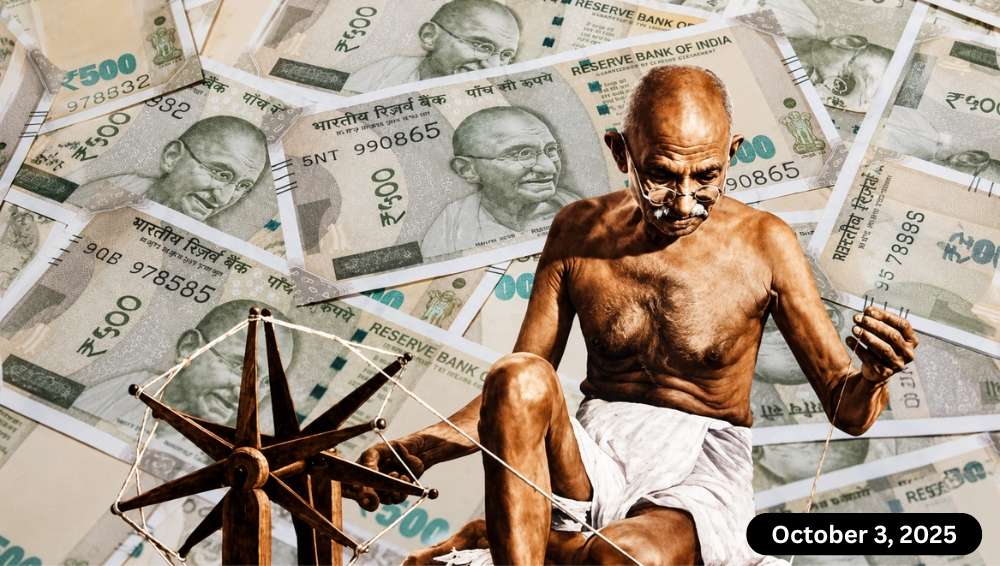
In today’s edition of Money & Machines, we look to our Father of our Nation Mahatma Gandhi as the country remembered him on his birth anniversary on October 2. He is the only person whose face appears on every rupee note in circulation—about Rs 34.8 lakh crore worth today — and he is also the leader who chose the charkha, a humble spinning wheel, as India’s machine of resistance against industrial power. Both choices—money and machines—continue to echo in surprising ways. |
|
On October 1, Prime Minister Narendra Modi released a special Rs 100 coin to mark the centenary of the Rashtriya Swayamsevak Sangh, the Hindu nationalist volunteer organisation. The coin, notably, carried the image of Bharat Mata — the first time she has appeared on Indian currency. |
The release came just a day before Gandhi Jayanti, which commemorates the birth of Mahatma Gandhi, the one figure whose face has become inseparable from Indian money. There is no law mandating that Gandhi alone must appear on notes or coins, and yet it is hard to miss the irony. As a new coin was struck to mark the 100th year of one organisation, Gandhi’s portrait reminded us to craft this newsletter as his image and philosophy, mainly 'Swadeshi' that has been repackaged as Make in India, or Atmanirbhar Bharat, in our times is still relevant today. |
Gandhi in your pocket |
India has roughly 155 billion notes in circulation, each carrying Gandhi’s portrait. This wasn’t always the case. In the first decades after Independence, notes carried the Lion Capital of Ashoka or motifs of agriculture and dams. Gandhi first appeared in 1969 on a Rs 100 note to mark his birth centenary. By 1996, the Reserve Bank of India standardised his image across denominations in what became known as the “Mahatma Gandhi Series.” Two decades later, the “Mahatma Gandhi New Series” followed demonetisation, bringing new colours, sizes and denominations. |
The portrait itself is based on a 1946 photograph of Gandhi with Lord Pethick-Lawrence. The decision to put Gandhi’s face on money was not simply aesthetic. Unlike the US, which features multiple presidents, or the UK, which leans on monarchs, India needed a single unifying symbol. Gandhi was broad enough to transcend regions and politics. The wager has endured. He may have resisted transactional politics, but paradoxically, Gandhi is the most transacted face in the world. |
The Charkha as a Machine |
If the rupee is India’s machine of trust, the charkha was Gandhi’s machine of production. At the height of British rule, India imported tonnes of cotton goods from Britain. Gandhi’s answer was not to replicate Lancashire’s mills but to decentralise spinning. A single charkha could produce up to 150 grams of yarn a day. Gandhi calculated that if 50 million Indians spun for half an hour daily, the country could generate enough yarn to blunt imports. |
The charkha was more than nostalgia. It was swadeshi economics in practice, blending politics with arithmetic. Its influence was sweeping by Independence, the wheel had transformed into the chakra on India’s tricolour, symbolising motion and progress. |
From Charkha to Mills |
Over time, the charkha receded as India industrialised. Today, the country hosts more than 50 million spindles in textile mills, powered by high-speed, computerised machinery. The humble spinning wheel survives in heritage and symbolism. KVIC, the Khadi & Village Industries Commission, sold Rs 1.7 lakh crore worth of khadi and village products in FY25, and in recent years has introduced solar- and electric-powered charkhas. But these are niches at the margins of a $165 billion textile industry. |
The contrast is stark. While Gandhi’s face dominates a $4 trillion economy and his charkha, once pitched as a rival to British mills, is absent from India’s modern textile powerhouses. Instead, the country imports billions worth of textile machinery annually, the kind of dependence Gandhi warned against. |
That contradiction is worth noting. The machine Gandhi trusted most has been reduced to heritage, while the money he never sought to own has multiplied his presence. |
Hence, Gandhi’s face on every note and his advocacy of the charkha both should be a reminder of his principle of swadeshi. If the rupee symbolises national trust, and the charkha symbolises self-reliance, together they form an argument for investing more domestic capital into India’s own startups and technologies. |
In an economy increasingly fuelled by foreign venture and private equity dollars, Gandhi’s symbols remind us of a balance yet to be struck. Money and machines were never just tokens for him — they were instruments of autonomy. That message, imprinted in every wallet and preserved in every spinning wheel, remains relevant as India looks inward to build its next phase of growth. |
But as the country looks more and more inward, it is also worth introspecting if Gandhi's face will continue to dominate our currency, or will some other images come to replace his. What is certain is that his philosophy will continue to trickle down in various shape and forms. |
-by Joseph Rai |

 6 min read
