🔥 Money & Machines |
In today’s edition of Money & Machines, we pull back the curtain on what followed our online gaming ban story — from late-night calls and even a bribe offer, to why it all felt worthwhile after a major crackdown by the authorities. In our Machines segment, we explore whether VCs have spotted their ‘Lovable’ in India yet? |
The Story Behind the Story |
On September 4, I wrote a piece on the shadow economy of online gaming. We didn't just rely on chatter – we tested it ourselves. Downloaded APKs, deposited, played, withdrew. The screenshots we put up showed the merchant names clearly. |
I thought that's it, done. But two days later, I get this random call. Some "Ray". He tells me to remove the name of a company called 'Apexio Sparx Technology Pvt Ltd' (which was part of the screenshot) from the story because "it's factually incorrect." I told him straight – can't do that. It is part of the test, and the screenshot is the proof. When he pressed on, I asked him something else that had been nagging at me: the story was behind a paywall. How could a company claim it was suffering so much from something with such limited reach? |
That wasn't the last call. |
Then, a few days later, another call. This time from a PR agency. Same request: take down the company's name. But here she added – they were willing to pay me. She wasn't saying who the client was until I agreed, so I played along for a bit. Asked her "ok, how much money is your client ready to offer?" She said, "30-40" (don't know whether she meant thousand or lakh, I cut her off right there). I pushed her again to reveal the client's name, and yes, it was the same 'Apexio' – exactly what I suspected from the start. At that point I got angry – told her to tell her client to not make these demands again. |
Still, the calls didn't stop. |
|
The day I made the story free, that night around 8-9 pm, I got another call. This time by a woman who literally started crying. She pleaded with me to remove two names, Apexio and Orielfin (another name that was part of our screenshots) – one I already knew, the second was new. She said both companies have a common owner. Apexio's account had been frozen, her money was stuck there, and if I didn't help, her December wedding would be ruined. And in between all the crying she kept saying things like – 'What do you want? Is it about money? I'll talk to the owner etc etc…' |
When I refused, she kept calling again and again. Around 10:30 pm, I finally picked up. She said she could come meet me face-to-face that night itself. I told her clearly – I can't take down names. What I can do is at least see proof of what she's saying. She eventually shared a mail screenshot with me. |
That's when I was shocked. The mail was from the Directorate General of GST Intelligence, marked to Yes Bank officials and cyber cell, asking for details of the account of Apexio Sparx Technology Pvt Ltd. Same VPA as in our screenshots. But here’s the interesting thing – the mail was sent on September 4 at 6:07 pm. Our story went live at 6:01 pm. Coincidence? Maybe. Impact? I'd rather believe impact :) |
But her argument kept puzzling me. I kept asking – if the matter is already with the government and cyber cell, how does taking down their names from my story help? Who told you that removing names from the story will get your account unfrozen? She just kept saying that's the only help she needed. |
That night, out of frustration, I put up a small LinkedIn post (without identifying anyone) about these back-to-back calls. And strangely enough, the calls stopped. |
And then I saw a news break today by The Times of India, which reports: Raigad cyber police said they've busted a Rs 350-crore illegal online gaming and betting racket. One person arrested from Rajasthan, with 44 mule accounts traced. Transactions worth crores linked to Apexio Ltd and others. Accounts of housewives, shop owners, random directors used to push hundreds of crores. Police are now probing possible involvement of bank officials – this is also something I reported in my story. |
[Excerpts from my story: According to sources, "some senior bank officials are involved in the online gaming industry in a way where they would set-up entities under their family members' name and the commission would flow into those entities."] |
When I look back, the back-to-back calls suddenly make sense. Those were more than pressure tactics. |
For me, this is the part of journalism people don't usually see. The late-night calls, the emotional blackmail, the subtle threats, the offer for bribes. All the stuff that happens after the story is out, and in some ways, confirms we were reporting in the right direction. These stories behind the story never make it to the final piece, but they shape the very essence of it. |
And I thought, being an avid reader, subscriber and supporter of The Head and Tale brand of journalism, you should also know this behind-the-scenes story of our story. |
[PS: I hope I get the names of the bank officials behind the company soon]. |
-by Arti Singh |
|
Have VCs spotted their Lovable in India |
By now, one can bet that someone with even a sliver of interest in AI would be aware that the Swedish startup, Lovable, by the sound of it, is not a dating app — but it can help create one. |
And one doesn't necessarily need to be a technical user to create apps and websites on Lovable. They just need to be handy with the right prompts. |
Welcome to the world of vibe-coding where AI-powered development platforms like Lovable have already been showered with inordinate venture capital (VC) money. Lovable turned into a unicorn just within eight months of its launch after it raised a whopping $200 million in a Series A funding round in July this year led by Accel. |
Interestingly, the vibe-coding spirit had been building up in India and VCs are already jumping in to place their bets on them. |
|
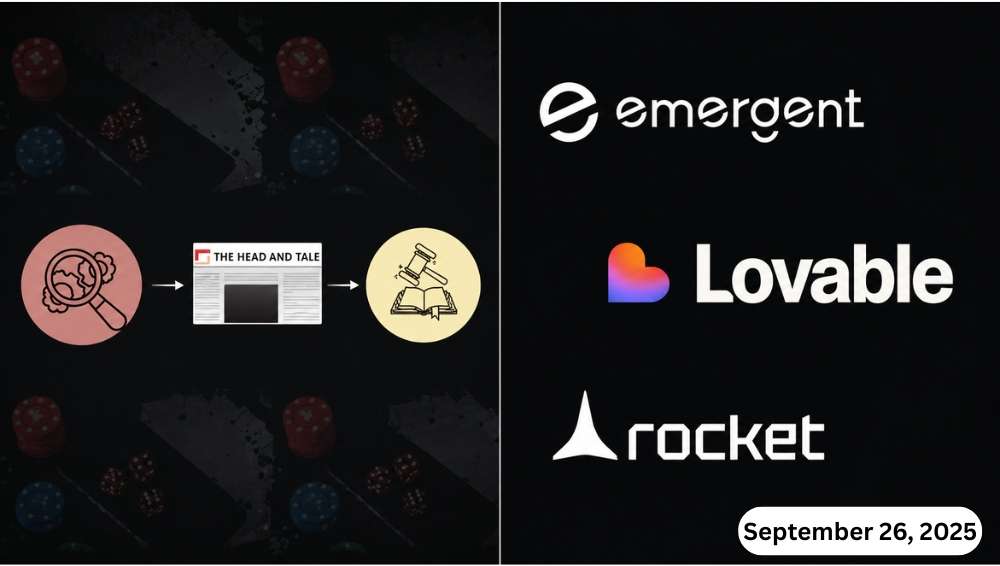
Just this week, two Indian vibe-coding startups – Emergent and Rocket.new — attracted significant early-stage cheques from VCs. |
Emergent raised $23 million in Series A funding led by Lightspeed and participation from Together Fund, Y Combinator, Prosus Ventures and angel investors including Jeff Dean, chief scientist at Google DeepMind. The startup, founded by twin brothers Mukund Jha and Madhav Jha, also claims that it has already hit $15 million in annual recurring revenue (ARR) in three months. |
Hemant Mohapatra, partner, Lightspeed, noted in an X post that Emergent is “building one of the fastest growing AI startups anywhere in the world.” |
Meanwhile, Rocket.new scooped $15 million in seed funding round co-led by Salesforce Ventures and Accel. Notably, the startup does not come from big metros. It is based in Gurajat’s Surat, known for its diamond polishing industry. The startup, founded by Vishal Virani, Rahul Shingala and Deepak Dhanak, claims that it already has a user base of more than 400,000 customers across over 180 countries, with the US leading the way. Interestingly, Rocket.new, which is a pivot from Virani’s earlier venture DhiWise, seeks to take vibe-coding a notch higher to “vibe solutioning”. |
The deals in the vibe-coding startups in India will not be limited to these two companies as VC interest in the space remains high and they generally tend to follow the herd mentality. |
An early-stage VC told The Head and Tale that it has been asking its team to use Lovable and also knows of a few of its peers encouraging the same, in a clear indication that they are scouting for similar startups emerging out of India. |
To be sure, the coding space at large and VC interest in it has not been non-existent in India. Builder.ai, an Indian-origin no-code startup, founded in 2016 by Sachin Dev Duggal, had raised significant funding before it filed for bankruptcy for financial malpractices this year. |
Notwithstanding such fiasco like Builder.ai, it is undeniable that the buzz around the more advanced vibe-coding segment in India is unmistakably high. |
However, only time will tell if the current crop of vibe-coding startups in India will be able to replicate the rise of the likes of Lovable and distinguish themselves from pitching for growth capital and attracting more users. |
-by Joseph Rai |

 9 min read

