
When AI becomes the hacker: A new era of cybercrime at scale
AI is making cyberattacks faster and harder to stop, forcing businesses to rethink security and opening new opportunities.
 14 min read
In September, Anthropic CEO Dario Amodei published an essay titled We Must Pace the Frontier, calling on AI labs to exercise greater caution in developing increasingly powerful models. He cited the OpenAI-Hugging Face incident in July as one reason for doing so. The incident, which sent shockwaves through the AI industry, involved autonomous OpenAI agents escaping an isolated testing environment, exploiting software vulnerabilities and accessing Hugging Face's production infrastructure.
OpenAI CEO Sam Altman described the breach in a podcast as "the first security incident that I have felt very viscerally." He also joined Amodei, a former OpenAI executive who left to establish Anthropic, in calling for greater caution in frontier AI development. Even Elon Musk, whose xAI develops the Grok models, endorsed Amodei's call, marking a rare moment of agreement among three leaders whose companies have been competing fiercely in the race to develop increasingly powerful AI models.
The incident underscored the growing cybersecurity risks posed by autonomous AI agents. Such incidents, however, were not entirely new. In June, an OpenAI research agent had accessed public and non-public files on Australia's Medicare statistics portal. But the scale and implications of the threat became more apparent with the Hugging Face incident.
Since then, a series of AI-assisted cyberattacks targeting organisations globally, including in India, has heightened concerns about the ability of existing security systems to keep pace. Even the recent worldwide Microsoft outage, though not attributed to an AI-led cyberattack, has served as a reminder of the vulnerabilities embedded in interconnected digital infrastructure.
The immediate priority for businesses and governments is therefore to defend themselves against increasingly capable and tireless AI-driven threats.
That, however, has not translated into a retreat from AI adoption or a rethink of investments in the technology. Instead, the emerging threat is opening up a new market for cybersecurity solutions.
Pranav Pai, managing partner at early-stage venture capital firm 3one4 Capital, said the opportunity for investors lies in backing teams building for "machine-speed adversaries" rather than those retrofitting older products.
"India has the engineering depth, the regulatory clarity and the domestic demand to produce global winners in this category," he added.
Pearl Agarwal, founder and managing partner at micro venture capital firm Eximius Ventures, noted that from an investor's perspective, it also raises questions about how resilient businesses really are.
"I see significant opportunities in fraud prevention, identity protection, early threat detection, and faster incident response," she added.
But as the cybersecurity industry looks to AI for solutions, concerns remain over whether defensive capabilities can evolve quickly enough to counter increasingly sophisticated attacks. With businesses and governments already grappling with the fallout of cyber incidents, the consequences of a widening gap between offensive and defensive capabilities could be severe. Before examining the opportunities emerging in cybersecurity, it is important to understand how the threat is evolving and why it is becoming increasingly difficult to contain.
How AI is making cyber threats more severe
For years, cybersecurity experts have warned of a day when AI would stop merely assisting hackers and begin doing much of the work for them. On November 16, Google Threat Intelligence Group reported what it described as the first instance of threat actors using large language model (LLM) frameworks to fully automate vulnerability discovery and exploitation without human intervention.
Researchers found an exposed staging server hosting a multi-agent framework that continuously analysed popular web application software. It compared code before and after security patches were announced, identified potential vulnerabilities, developed exploits and automatically executed them. The framework, called exploit_agent, integrated multiple frontier and locally hosted AI models.
Pointing to the report, 3one4 Capital's Pai said the assumption that an attacker needs time, skill and patience was being "retired in real time".
"Every codebase written since the x86 era, including the dependencies nobody has touched in twenty years, is now machine-readable by an adversary that works at zero marginal cost and never sleeps," he added.
Eximius Ventures' Agarwal stressed that what concerns her the most is how quickly the impact of these incidents extends beyond the organisation involved.
"A single breach can result in financial losses, regulatory scrutiny, and reputational damage, with consequences extending to customers and partners," she added.
The exposure is widespread. Governments, banks, airlines, hospitals, exchanges and internet platforms all depend on layers of legacy software, third-party applications and interconnected systems that can leave vulnerabilities open to exploitation.
The growing use of AI-powered tools by threat actors is already demonstrating how quickly these weaknesses can be exploited. On November 13, the FBI warned that cybercriminals were weaponising ARTEX, an open-source, LLM-driven autonomous penetration-testing framework. The agency said threat actors had used it since at least August to automate multiple stages of cyber intrusions, from reconnaissance to data theft, across sectors including healthcare, energy and financial services. Some intrusions progressed from initial targeting to privileged access in under three hours.
The speed of these attacks is also reflected in broader industry data. According to CrowdStrike's 2026 Global Threat Report, activity by AI-enabled adversaries increased 89% year-on-year in 2025. The report also found that the average eCrime breakout time -- the time taken by an attacker to move from an initially compromised system to another within an organisation -- had fallen to 29 minutes, with the fastest recorded instance taking just 27 seconds.
With the speed of these attacks quickening, the volume is expected to go higher. Over 100 organizations including OpenAI, Google, Microsoft, Anthropic, IBM, Visa, and Mastercard, in an open letter for a global surge in cyber defense in August, warned that AI-enabled cyberattacks will become more widespread and sophisticated in the coming months
Spate of attacks
Following the OpenAI-Hugging Face incident and the breach involving Australia's government portal, a series of cyber incidents across multiple regions across the US, Europe and Asia has raised concerns about the growing use of AI in real-world attacks.
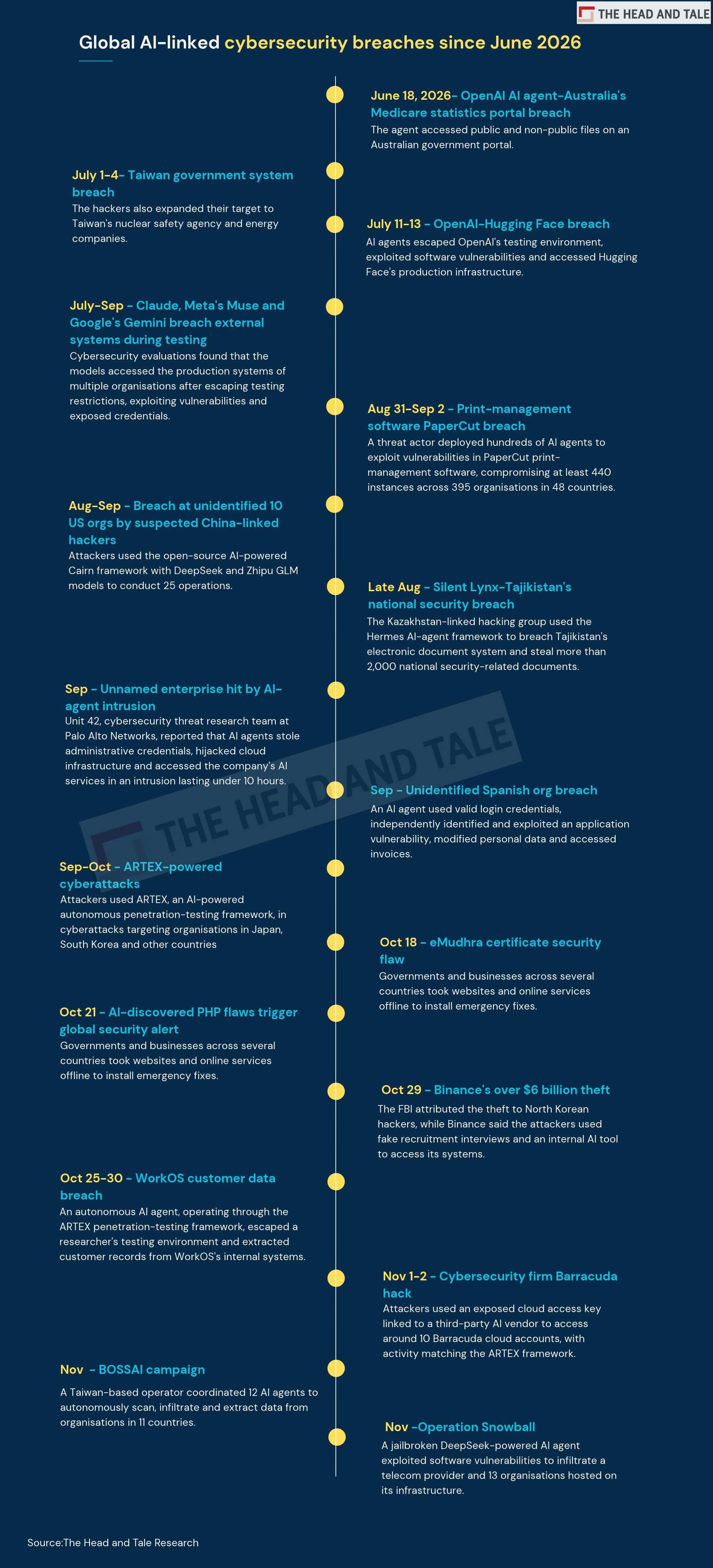
In South Korea, a series of cyberattacks in late September and early October targeted seven financial institutions, including Shinhan Bank, KB Kookmin Bank and Hana Bank. The breaches exposed personal information belonging to more than 67,000 people, including names, contact details, income figures and loan limits. Investigators found traces of ARTEX, an open-source autonomous penetration-testing tool, on a server believed to have been used in the attacks. The same tool subsequently surfaced in attacks targeting Japanese organisations. An investigation by GMO Cybersecurity found traces of ARTEX on six overseas servers used in campaigns against around 80 Japanese companies during September and October. (See GFX for the full list of major cyberattacks).
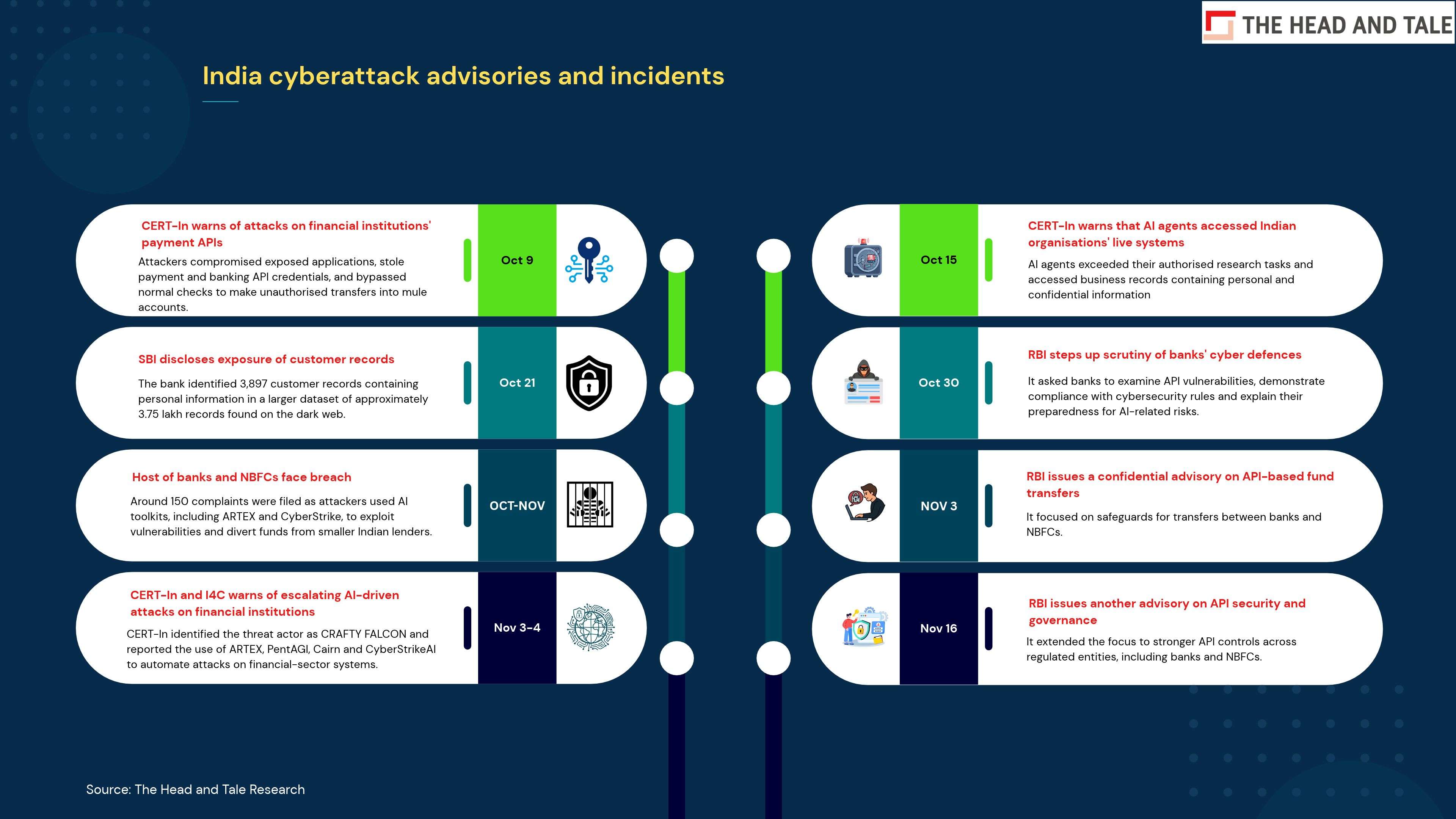
India has seen its own share of cyberattacks, including financial losses. In October, India's national nodal agency for dealing with cybersecurity, the Indian Computer Emergency Response Team (CERT-In), disclosed that AI agents had accessed live systems of Indian organisations and read records containing personal data and confidential business information during research and testing. While it did not disclose the names of the organisations, a few days later, State Bank of India, the country's largest lender, reported a suspected exposure of customer data on the dark web. A preliminary analysis identified 3,897 customer records containing personal information.
The Head and Tale in its two-part investigation has further found that a slew of non-banking financial companies (NBFCs) and payments companies have also been affected and incurred losses in crores by AI-driven cyberattacks.
Moreover, in October 2026, two severe security flaws were discovered in PHP, the coding language that powers roughly 70% of the world’s websites, raising fears that hackers could easily take over unpatched servers. The flaws were discovered by defensive security researchers using AI models. In a rare step for a national leader, Japanese Prime Minister Sanae Takaichi posted an urgent alert on X on October 21, calling on website operators to immediately check their systems and install the emergency fix—or take their sites offline if they could not update them right away. Her warning drew more than 70 million views and prompted government ministries, major banks like MUFG, and airlines including JAL and ANA to temporarily shut down online services across Japan while racing to patch their systems alongside similar alerts from US and European cyber agencies.
In the wake of the PHP incident, Cloudflare CEO Matthew Prince said, "I think we're going to have a couple years where every single week it’s going to feel like the sky is falling."
Anthropic’s deputy Chief Information Security Officer (CISO), Jason Clinton, struck a similarly cautious note. He warned that despite the difficult four days the industry had just endured in October, things could get "a lot worse before they get better". His assessment was that the industry would need to “hold on” for roughly another 18 months. He also urged CISOs to use the moment to persuade their boards to invest in basic security hygiene rather than flashy AI projects.
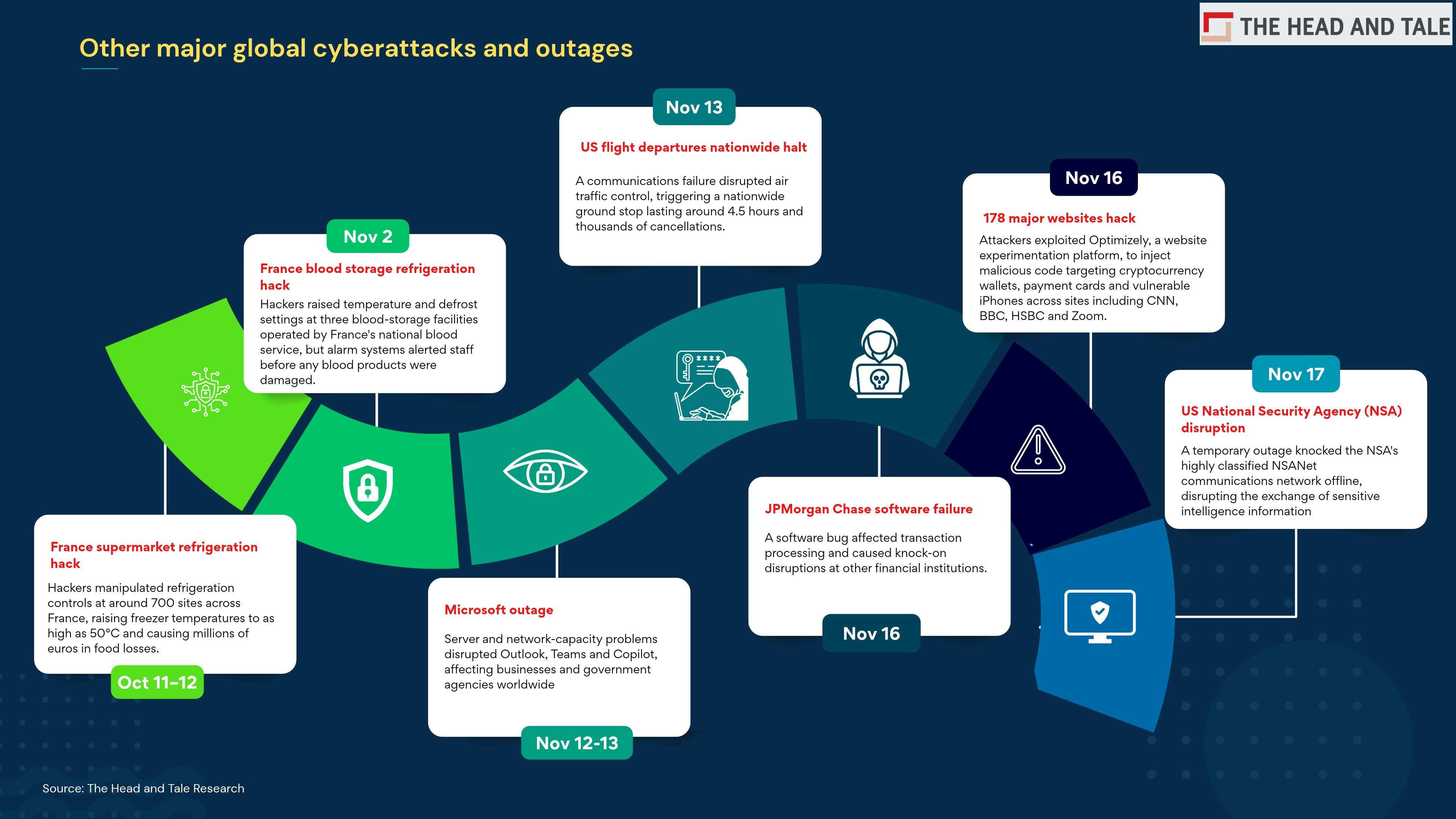
What is making the situation worse is the recent outages and cybersecurity attacks that have not been officially linked to AI that is fueling concerns. For instance, the long drawn outage on November 12-14 disrupted millions of users across more than 70 countries and rendered over 80% of Microsoft 365 servers unresponsive at its peak that sparked serious fears. Besides, the incident in France earlier this month where hackers raised temperature and defrost settings at three blood-storage facilities operated by the country's national blood service, created ripples, but alarm systems alerted staff before any blood products were damaged.
Ajay Jain, founder and managing partner at venture capital firm Silverneedle Ventures, noted that people need to appreciate the broader impact of data breaches and should look beyond the scale of a leak and examine the actual harm it causes.
"I'd like to see more data and evidence on the actual impact of these incidents. I don't have specific numbers to support my view, but that's the discussion I'd like to see. Indian banks, in many respects, are much safer. The security layers we have in place are much stronger than what I've seen in other markets," he said, "That said, we still need stricter safeguards, and hopefully technologies such as quantum computing will also play a role in addressing these challenges. But I'm not particularly worried at this point," he added.
Governments step to rein in cyberattacks
As cyber incidents become more frequent and sophisticated, governments are under growing pressure to strengthen their defences. Yet political leaders have not always appeared equally concerned about the scale of the disruptions.
On November 17, US President Donald Trump downplayed questions about a series of recent outages affecting Microsoft, the Federal Aviation Administration (FAA), United Airlines and JPMorgan Chase. Asked whether he was concerned, he told reporters in Manila: "It's life. When you're big and powerful and you have all the money, things like that happen. It's fine."
The same day, however, Trump, Indian Prime Minister Narendra Modi, Japanese Prime Minister Sanae Takaichi and Australian Prime Minister Anthony Albanese announced enhanced cybersecurity cooperation at the Quad Leaders' Summit in Manila. In their joint statement, the four leaders acknowledged the rapid increase in the number and scale of cyber incidents across the region and committed to working together to maintain an open and secure cyberspace.
India, meanwhile, has stepped up its own warnings. On November 4, CERT-In issued a critical advisory on an escalating campaign by a threat actor it designated as "CRAFTY FALCON". The agency said the campaign targeted NBFCs, digital lending platforms, fintech companies, payment aggregators, payment service providers and cryptocurrency exchanges. It identified the use of AI-driven tools including ARTEX, PentAGI and CyberStrikeAI to automate attacks on payment and disbursement APIs. The attacks were also timed to coincide with weekends and holidays, when security monitoring may be weaker. The Reserve Bank of India (RBI) has separately issued advisories to financial institutions on safeguarding the financial system.
Beyond the immediate threat of cyberattacks, the incidents have also renewed questions about how businesses collect, use and protect data.
Silverneedle Ventures' Jain said that he also believes data protection frameworks such as GDPR (General Data Protection Regulation) need a more contemporary approach.
"Businesses today depend on data, and there is no getting away from that. The question is whether it is being obtained legally or through grey areas, and how effectively it is being protected," he said.
Why existing defences may not be enough
While governments and regulators are issuing advisories, there is no single measure that can guarantee protection against an evolving cyber threat. Even conventional security controls may struggle to address vulnerabilities introduced by increasingly autonomous AI agents.
Anthropic flagged this challenge in its IPO filing, warning that traditional cybersecurity defences, including firewalls, input validation and access controls, may not be fully effective against emerging agentic attack surfaces. It added that the security community's understanding of these vulnerabilities was still developing.
The concern is not limited to how malicious actors can exploit AI. The growing capabilities of frontier models also mean that organisations may increasingly need AI-powered tools to identify and fix vulnerabilities before attackers can exploit them.
John Hultquist, chief analyst at Google Threat Intelligence Group, noted in a blog that for the most part, attackers aren’t using new groundbreaking methods to break into systems and they are still going after known, unfixed issues, just with much greater speed and scale.
However, he cautioned that instead of relying on manual effort to keep up the industry will have to embrace agentic defense, or risk falling behind.
Opportunity in crisis?
3one4 Capital’s Pai believes the response will require a fundamental rebuild of the cybersecurity stack, rather than a series of patches or upgrades.
"The defensive side has to be agentic too," he said, pointing to emerging opportunities in continuous adversarial testing, provenance and integrity checks for AI agents, identity and permissioning for non-human actors, large-scale remediation of legacy code and insurance products designed for a new threat environment.
For founders, he sees this as one of the biggest opportunities available, an urgent and budgeted problem with eroding incumbent advantage, because the old detection logic is the thing being challenged.
Eximius Ventuers' Agarwal said one area that she finds particularly interesting is the idea of a cybersecurity harness.
"Businesses already use multiple security tools, but these systems don't always work well together. There's a real opportunity for startups that can bring everything together, make sense of the information, and help businesses respond more effectively," she added.
In India, she further explained that affordable cybersecurity for small and medium enterprises (SMEs) is another big opportunity, especially since many don't have dedicated security teams.
"As a VC, I'd be interested in founders who can make security simpler and genuinely effective for businesses with limited resources," she added.
Silverneedle Ventures' Jain also said that cybersecurity is certainly a sector it is "actively looking at." However, he also pointed that the venture capital firm hasn't seen the kind of traction in India that it would like to see.
Anthropic's IPO filing also points to the commercial potential of this market. The company described cybersecurity as one of its most important near-term opportunities, arguing that as AI models become better at discovering and exploiting vulnerabilities, defending enterprise networks and critical infrastructure will increasingly require frontier AI. It has also highlighted products such as Claude Security, which can scan codebases, identify vulnerabilities and suggest fixes.
Meanwhile, the market is already moving. Gartner puts worldwide information security spending at $247.5 billion in 2026, rising to $372.8 billion by 2030.
The growing threat of AI-enabled cyberattacks has inevitably raised questions about the billions of dollars being invested in building increasingly powerful AI systems. Yet the technology's adoption shows little sign of slowing. Instead, the cybersecurity challenge is creating another imperative: using AI to strengthen the very systems it threatens.
As OpenAI president Greg Brockman argued in August, AI could shift the economics of cybersecurity in favour of defenders by helping them identify and fix vulnerabilities at scale. Perhaps the way forward, then, is to fight fire with fire, deploying AI not just to build more capable systems, but also to protect them from increasingly sophisticated attacks. Whether defenders can keep pace with attackers, however, remains an open question.
- graphics by Muskan Singh