
Shiprocket IPO: A profitable core, costly emerging bets
Concerns around Shiprocket profitability, the still-evolving nature of its emerging business, heavy dependence on vendors continue to weigh as it prepares for IPO.
 11 min read
When Eternal (formerly Zomato) invested in Shiprocket in 2021 as part of a $185 million Series E funding round, the move drew scrutiny over potential conflict-of-interest concerns after former Infosys director TV Mohandas Pai raised questions in a post on X.
Responding to Pai, then Zomato CEO Deepinder Goyal clarified on X that he had exited his personal investment in Shiprocket at zero profit before the food delivery major invested in the logistics aggregator. “There was no conflict of interest to begin with,” Goyal had stated.
Beyond the controversy, the episode also brought attention to Shiprocket, a company that operates largely outside consumer visibility but plays a critical role in enabling online commerce. Unlike consumer-facing platforms such as Eternal, Shiprocket has built its business in the background, working with merchants and logistics partners rather than engaging directly with customers.
As it heads toward an initial public offering (IPO), Shiprocket is betting that the infrastructure backbone created through its “core business” and the “emerging business” it is building will anchor its next phase of growth.
.jpg)
However, while it highlights a large and diversified merchant base as a key strength, concerns around profitability, the still-evolving nature of its emerging business, heavy dependence on vendors and integration-related adjustments arising from past acquisitions continue to weigh as it prepares to tap public markets.
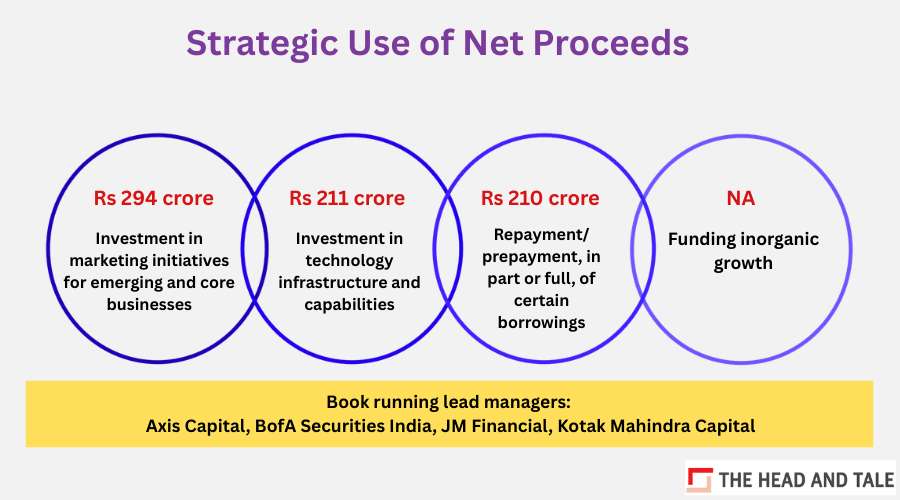
The company is also developing data analytics and artificial intelligence (AI) capabilities, a strategy that will require sustained investment. While this signals an attempt to stay ahead of industry shifts, it, like many firms, faces risks over how effectively these capabilities will translate into financial returns.
Before dissecting these concerns, it is useful to examine its core and emerging businesses as described in its updated draft red herring prospectus (UDRHP).
Core and emerging business
Founded in 2012 by Saahil Goel, Gautam Kapoor and Vishesh Khurana as Bigfoot Retail, Shiprocket initially focused on ecommerce enablement through platforms such as KartRocket under a “Shopify for India” vision. However, as the founders worked closely with small online sellers, they realised storefront creation was only part of the challenge; fulfilment and shipping proved to be far bigger bottlenecks. Around 2015, the company began evolving toward logistics aggregation and formally launched Shiprocket as a dedicated shipping platform in 2017.
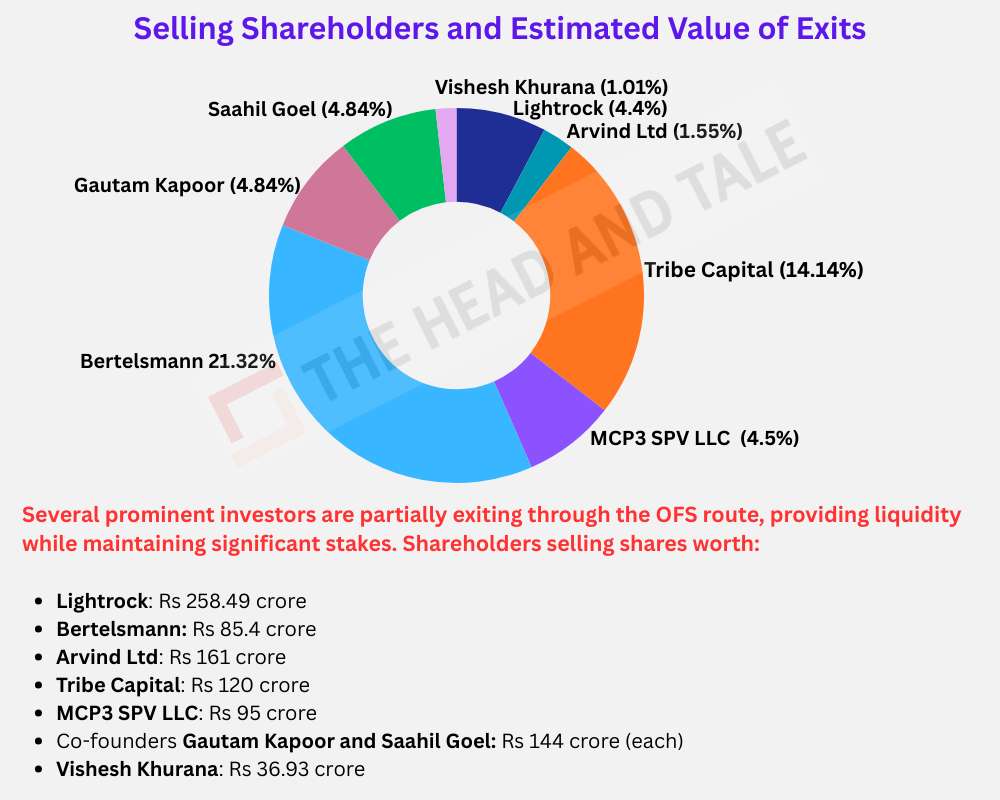
As it scaled and attracted investor capital, Shiprocket structured its operations into “core business” and “emerging business” segments, a distinction that now frames its IPO narrative.
Its core business comprises its domestic shipping platform and shipping apps, offering end-to-end delivery solutions across courier partners within India along with tracking, order management and logistics optimisation tools. The emerging business spans cargo and fulfilment services, cross-border logistics, marketing and advertising tools, and merchant financing solutions.
Within this, it also categorises hyperlocal delivery or quick commerce, a segment that has gained traction in India and where Eternal’s Blinkit presence makes the investment strategically aligned.
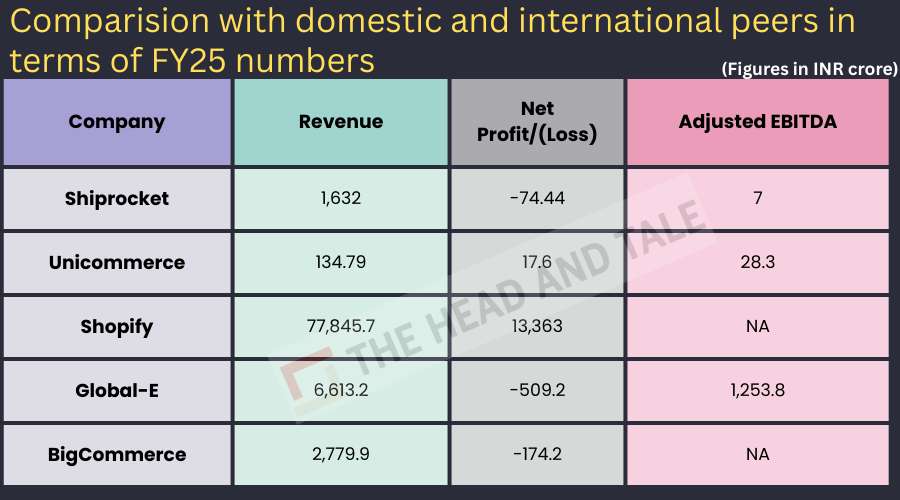
Eternal, which holds a 6.85% stake, is not selling shares via the offer for sale (OFS) route. Based on Shiprocket’s estimated valuation, Eternal’s stake is worth close to Rs 700 crore compared to the roughly Rs 550–560 crore it invested in 2021. While the upside may not appear dramatic, Shiprocket’s revenue from operations has more than doubled to Rs 1,632 crore since FY22 when it stood at Rs 611 crore.
Yet revenue growth has not translated into profitability, and rising expenses in the emerging business suggest margins remain some distance away.
Profitability concerns
In the UDRHP, Shiprocket identifies losses as its top internal risk.
Its net loss narrowed to Rs 38.32 crore in the first six months ended September FY26 from Rs 42.3 crore in the corresponding period last year. However, annual losses have widened from Rs 35.93 crore in FY23 to Rs 74.44 crore in FY25.
.jpg)
.png)
The increase is linked to expansion into new product categories, geographies and consumer segments, particularly within its emerging business.
Notably, the core business has been profitable at the operating level through FY25 and in the first half of the current fiscal. The emerging business, however, continues to report operating losses, narrowing in FY25 but rising again in the first half of FY26, indicating the vertical is yet to stabilise.
By its own admission, Shiprocket may continue to incur operating losses, particularly in the emerging segment, as it invests in expansion, AI capabilities and acquisitions.
While it is not uncommon for new-age technology companies to go public while loss-making, markets have approached such listings cautiously. Delhivery, one of Shiprocket’s major logistics vendors, was loss-making at its 2022 IPO and reported its first full-year profit only in FY25, underscoring the longer gestation typical of logistics platforms.
In contrast, ecommerce enablement platform Unicommerce eSolutions was profitable at its 2024 IPO and has largely maintained profitability, though Shiprocket operates at a far larger revenue scale.
How solid is its emerging business?
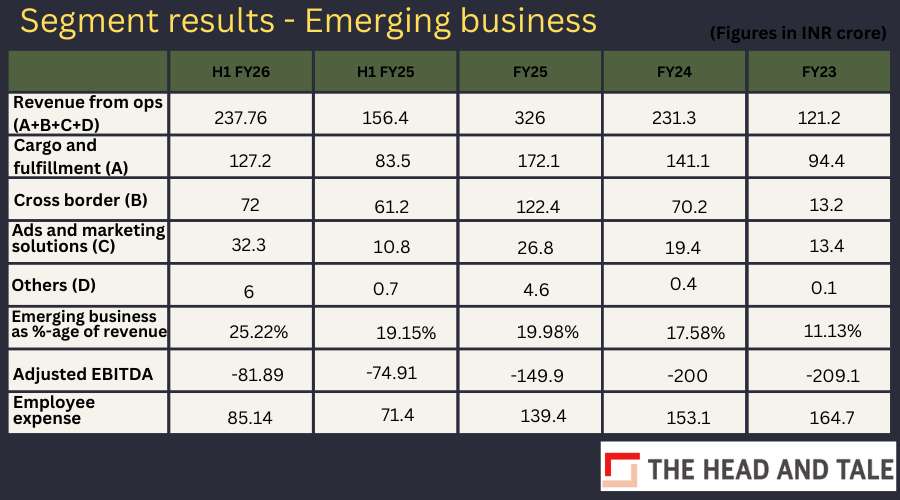
The emerging business contributed a quarter of revenue in the first half of FY26, indicating traction. However, rising expenses continue to pressure margins.
Cargo and fulfilment form the largest share, nearly doubling to Rs 172 crore in FY25 from Rs 94 crore in FY23. The company plans to introduce express deliveries and expand into bulk and cargo services, enabling SMEs to access a digital export platform across categories including apparel, handicrafts and ayurvedic products.
However, Shiprocket does not have exclusive arrangements with cargo or courier partners. “Any of the foregoing could have an adverse effect on our business, financial condition, cash flows and results of operations,” it noted. It operated 15 leased fulfilment centres across 10 cities as of September 30, 2025 and managed eight customer-owned centres.
The cross-border segment rose sharply to Rs 122 crore in FY25 from Rs 13 crore in FY23. ShiprocketX enabled cross-border trade for 4,555 merchants with GMV of Rs 311.58 crore through 20 partners in the six months ended September 30, 2025. However, regulatory complexity could raise compliance costs.
Ads and marketing tools remain a smaller portion but may enhance stickiness. For instance, its cash on delivery (COD)-risk tool nudges customers toward prepaid payments and flags high return-to-origin (RTO) addresses, significant in a market where COD remains widespread.
 The company has also entered financial services under a pilot “first-loss default guarantee” model. Although it does not directly lend, it bears risk if merchants default. While currently small, this is a competitive space.
Shiprocket Quick, launched in Q3 FY25, began generating revenue in Q4 FY25 and covered 58 cities with 7,070 active merchants and 48,382 unique transactions for the three months ended March 31, 2025. However, evolving regulatory norms in hyperlocal delivery could raise compliance costs.
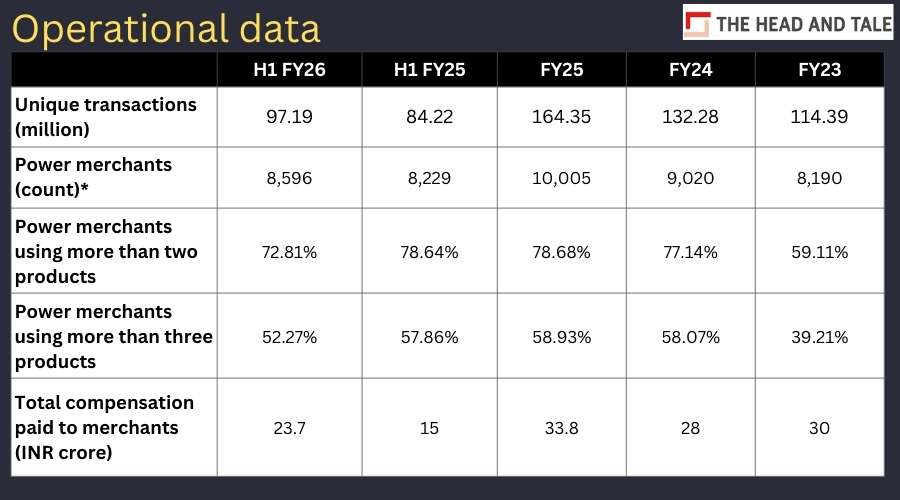
The emerging business remains early-stage, but merchant adoption indicates potential. In FY23, 97% of merchants joined through the core business; in the six months ended September 30, 2025, that figure declined to 76%, reflecting growing entry through emerging offerings.
AI
The joint venture with Ultrasafe AI and others underscores Shiprocket’s intent to deepen its capabilities in AI, not just as an add-on but as a foundational layer across its platform. Shiprocket’s CEO Saahil Goel has repeatedly emphasised that AI is not a hype but a long-term transformative force, capable of driving efficiency and innovation rather than merely replacing tasks.
This shift is already visible in initiatives like Shunya.ai, a multimodal AI model developed with Ultrasafe that is tailored for small and medium enterprises and supported by Indian commerce data.
However, as on the date of filing this UDRHP, which was on December 13, 2025, the company said it has not yet infused capital into the joint venture, and any investment will be made at a later stage subject to mutual agreement.
This suggests that while AI features prominently in Shiprocket’s strategic narrative, execution on certain initiatives remains at an early stage.
Acquisitions
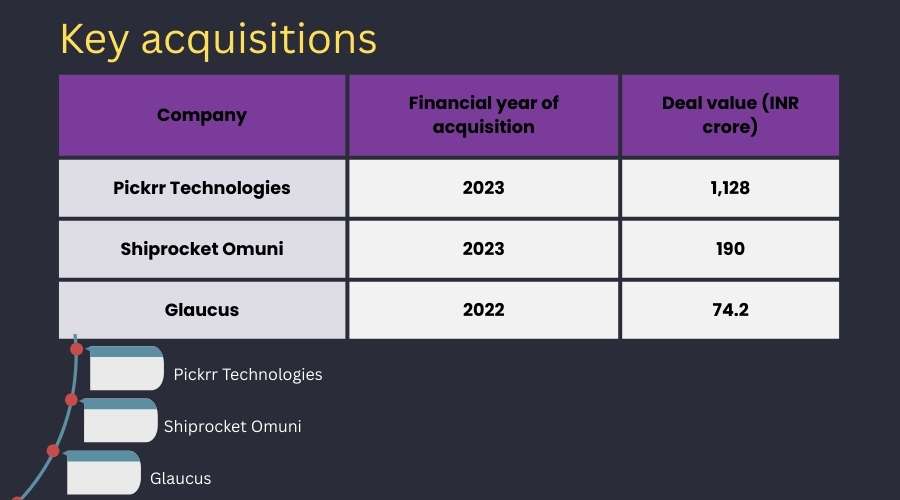
Shiprocket has actively taken the inorganic route to shore up its business with major acquisitions including Pickrr for upwards of Rs 1,000 crore and Omuni for around Rs 200 crore.
In the UDRHP, the company has pointed that the acquisition of Pickrr in 2022, its closest competitor, strengthened its pre-checkout capabilities, complementing its largely post-checkout shipping-focused product stack.
But integrating the acquisitions have been challenging. Shiprocket spent heavily in FY23 and FY24 to grow its business and integrate the companies it had acquired. During this integration process, it had to bear overlapping costs such as duplicate teams and systems which significantly increased its losses before exceptional items in those years. In addition, the company recorded exceptional losses, including impairment of goodwill and other intangible assets related to its acquisitions of Pickrr and Shiprocket Omuni, which further widened overall losses in FY23 and FY24. The silver lining is that from FY24 onwards, the company began realising operational synergies from these integrations, which helped reduce losses compared to earlier periods. Still, some challenges related to compliance continue to linger.
For instance, the UDRHP pointed that the company and its Indian subsidiaries have generally maintained proper accounting records as required by law. However, in the case of Pickrr between April 1, 2024 and December 31, 2024, backups of its electronic accounting records were not stored daily on servers located in India, as required under regulations. It further said that while Pickrr moved its accounting system from Tally to Oracle Netsuite starting January 1, 2025 for compliance reasons, the audit trail feature, which records changes made to financial data, was not enabled. As a result, the company pointed that it cannot confirm whether a proper record of changes was maintained in line with legal requirements during that period.
Apart from the compliance challenges faced by its subsidiaries, Pickrr could potentially be confronted with a legal issue.
The UDRHP noted that a company called QNT Sports India has started a criminal case against Pickrr in a court in Gurugram in October 2024. The case is currently pending, and as of the date of the filing, neither Shiprocket nor Pickrr has received any official notice or summons about this case, and they are aware of it only through publicly available information. If the court formally admits the case, Pickrr (and possibly Shiprocket) may be made a party to the proceedings.
In view of these challenges, and as the company aims to make more acquisitions in the future it has cautioned that it may be unsuccessful in making, integrating and maintaining acquisitions and strategic investments, which could hinder the growth of its business. “Failure to realize the economic benefit of such acquisitions could result in substantial impairment charges,” it stated.
It should be noted that the challenge of integrating an acquired entity is not exclusive to Shiprocket and the sector itself. But it also highlights the acquisition of its immediate competitor like Pickrr does not bring instant windfall and carries with it the integration, compliance and legal challenges.
Diversified merchant base but big dependence on vendors
The company’s merchant base has been diversifying which helps in reducing concentration risks. It served a merchant base of 145,269 active merchants in the six months period ended September 30, 2025.
In FY25, Shiprocket’s revenue concentration remained relatively low, with its top customer contributing 3.67% of revenue from operations, while the top five and top twenty merchants accounted for 9.70% and 20.20%, respectively. This diversification improved further in the six months ended September 30, 2025, with the top one, five and twenty merchants contributing 3.12%, 7.76% and 17.22%, underscoring the breadth of its merchant base and limited reliance on any single client.
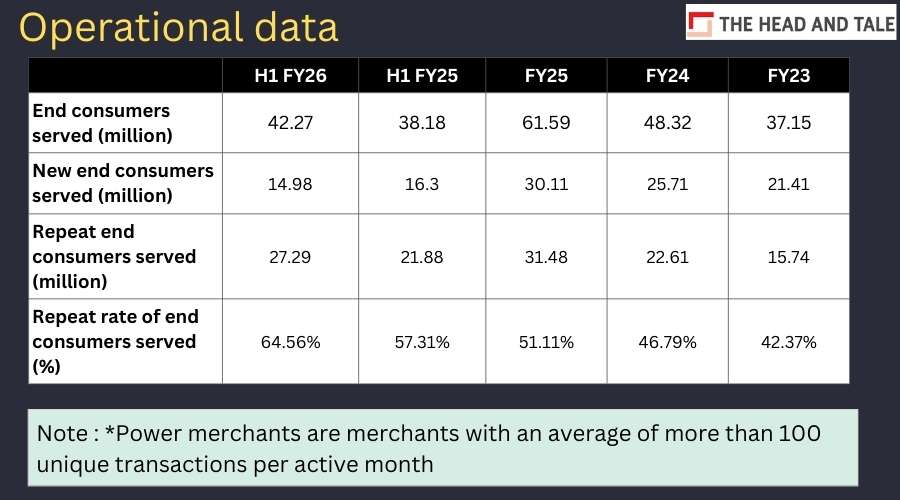
Notably, its so called Power Merchants, or merchants with an average of more than 100 unique transactions per active month, crossed the 10,000- mark in FY25 from 8,190 in FY23. But the volume growth year-on-year has been stagnant , increasing at the just around 11% pace in FY25. Similarly, Power Merchant average revenue per user (ARPU) increased to just Rs 14.4 lakh in FY25 from Rs 12.8 lakh in FY24.
So, while the declining revenue concentration indicates a diversified merchant base, sustained growth will still hinge on deepening engagement with higher-volume Power Merchants. Among its top 250 Power Merchants were digital-first brands such as Mamaearth and Boat alongside traditional offline brands like Levi’s, Bata and Blackberry that have expanded into ecommerce.
However, diversification on the merchant side does not eliminate risks elsewhere.
Shiprocket’s business depends heavily on third-party service providers to run its business. These include logistics companies, warehouse operators, cloud and tech providers, payment gateways, marketplaces and credit partners. A large portion of its total expenses, around 59% to 69% in recent years, went toward what it calls “Cost of Merchant Solutions,” which mainly includes payments to these external partners. This means a significant part of its cost structure is tied to vendors. If any of these partners increase prices, reduce services or face disruptions, it could negatively impact Shiprocket’s operations, profitability and overall financial performance.
As Shiprocket heads to the public markets, the question is not whether it has achieved scale, it clearly has, but whether its emerging businesses can mature fast enough to support margins and justify investor expectations. The core shipping engine provides stability, yet the company remains heavily dependent on external vendors and the successful execution of newer bets.
Ultimately, how Shiprocket balances growth with profitability discipline will decide whether its IPO marks a turning point and whether an infrastructure player can build brand recognition comparable to consumer-facing platforms such as Zomato.