Money & Machines: Infra.Market’s IPO detour; AI's water challenge

In this piece, we write on Hella Infra using Shalimar Paints for a backdoor listing after a year of rating trouble and debt refinancing; and how protests against Google's proposed data centre have opened up a larger conversation around water...
Money & Machines: Infra.Market’s IPO detour; AI's water challenge

In this Money & Machines newsletter, we write on Hella Infra using Shalimar Paints for a backdoor listing after a year of rating trouble and debt refinancing; and on the AI front, we write about how protests against Google's proposed data centre in Visakhapatnam have opened up a larger conversation around water, infrastructure and what responsible AI development should look like in India.

Hella Infra turns to Shalimar Paints for a backdoor listing

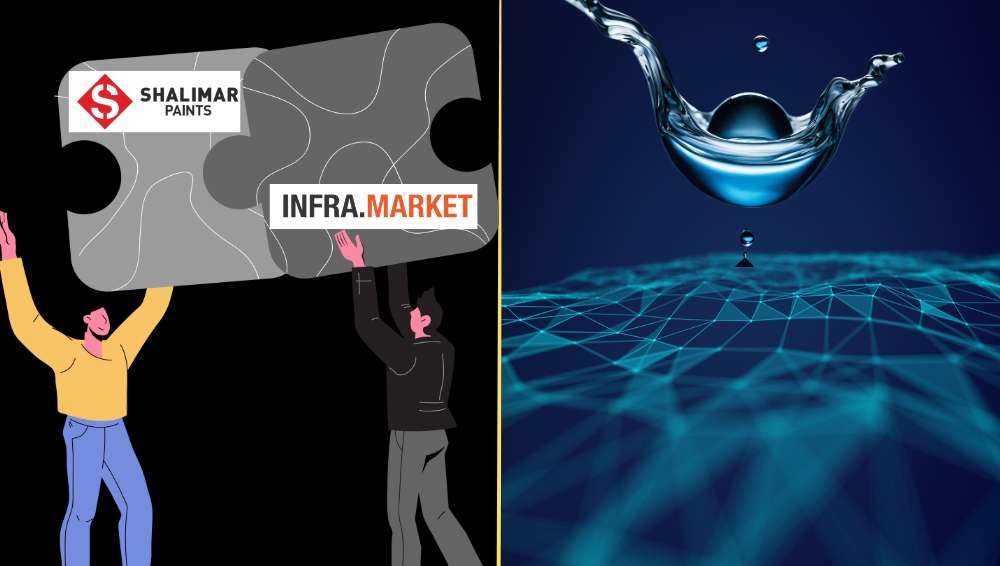
Seven months after Sebi cleared its Rs 5,000 crore IPO, Hella Infra Market, which operates B2B construction marketplace Infra.Market, is now pursuing a Rs 10,440 crore share-swap with its listed subsidiary Shalimar Paints. The move comes after a year marked by a sharp rating downgrade, non-cooperation with India Ratings, an insolvency petition by Israel Discount Bank and a CIBIL ‘Suit Filed – Large Defaulters’ entry involving CredAble.

The route through which Infra.Market reaches the public markets has taken an unexpected turn.

On August 12, Shalimar Paints, the 124-year-old listed paints company controlled by Infra.Market, approved a proposal to acquire shares and compulsorily convertible preference shares (CCPS) of its parent, Hella Infra Market Limited, through a preferential share swap. Under the proposed transaction, Shalimar will issue 41.70 crore equity shares worth Rs 3,544.69 crore and 81.12 crore CCPS worth Rs 6,895.22 crore to shareholders of Hella Infra, taking the total non-cash consideration to about Rs 10,439.91 crore. 

Shalimar has also proposed a separate Rs 1,000 crore QIP. 

The structure is unusual because Hella Infra already controls Shalimar and owns 52.85% of Shalimar Paints, making the latter its subsidiary. Shalimar's own filings identify Hella as its holding company. The proposed swap turns that structure with Shalimar acquiring a stake in Hella – making Hella an unlisted material subsidiary of the listed Shalimar Paints. 

Both companies have also discussed the possibility of “unification” at a later stage. 

In other words, the listed Shalimar Paints – an entity which is controlled by Hella Infra – is being used as the vehicle through which the unlisted entity Hella Infra could reach public markets.

And this comes just seven months after Sebi cleared Hella Infra's standalone IPO.

From a Rs 5,000 crore IPO to a listed-company route

Hella Infra had confidentially filed its IPO papers with Sebi in October 2025, proposing to raise around Rs 5,000 crore. In January this year, the Sebi gave a go-ahead to the company to proceed with the IPO process. 

The IPO announcement came at a time when Hella was carrying a substantial debt burden and had been relying on a combination of equity raises and debt refinancing. With the Accel Partners and Tiger Global-backed company choosing an unexpected alternative route to reach public market, it looks like that all efforts to do IPO failed.

Shalimar itself made the intent unusually clear in its exchange filing, describing the transaction as a “rare opportunity to bring business of Infra.Market's scale and ambition into the public markets” through Shalimar's listed platform. 

How fruitful this rare opportunity will turn out for retail investors only time will tell, but it is important to note that the change in strategy also comes after a year in which Hella's financial flexibility and access to capital came under considerable scrutiny.

The rating warning that Hella initially brushed aside

In September 2025, India Ratings and Research downgraded Hella Infra's bank facilities and non-convertible debentures – and more importantly, the rating agency migrated the ratings to the “Issuer Not Cooperating” category. India Ratings said Hella had failed to provide critical information despite repeated requests and that its rating was therefore based on the best available information. 

The agency said Hella's FY26 funding gap had widened to about Rs 1,100 crore, from roughly Rs 450 crore at its previous review. The company had earlier indicated term sheets of Rs 740 crore to refinance part of its FY26 repayments, but Rs 480 crore of the proposed NCD issuance had not materialised. An equity line of Rs 125 crore that was available under a Rs 200 crore share subscription agreement had also not come through. 

At the time, Hella had told India Ratings that the gap would be bridged through equity, debt and internal accruals. It had tied up Rs 730 crore of equity, of which Rs 437 crore had been raised by September 22, 2025, while another Rs 150 crore of debt was expected and a Rs 1,000 crore NCD term sheet was under negotiation. 

The agency also said some proposed debt funding was coming at considerably higher interest rates, potentially weakening Hella's credit metrics. Interest coverage was only 2.7 times in FY25. Its working-capital limits were being utilised at an average 97% at month-end between April and July 2025, touching 99% in June 2025 – “indicating the erosion of liquidity cushion in the limits,” the rating agency had added. India Ratings also said Hella had deferred payments to some operational creditors, although management had told the agency those liabilities had no recourse to Hella. 

The agency had stated that Hella's consolidated net debt had risen to Rs 4,370 crore in FY25 from Rs 3,130 crore a year earlier, while standalone net debt including leases had risen to Rs 2,500 crore from Rs 1,480 crore. 

India Ratings also said Hella had not provided its 1QFY26 operational and financial performance, current liquidity and working-capital position, capex and funding updates, consolidated net debt and repayment schedule, or information on its Singapore subsidiary. The agency warned that such non-cooperation could indicate weak transparency and potentially a disruption or distress in the issuer's credit profile. 

At that time when The Head and Tale had sent queries to Hella Infra, the company brushed off the downgrade and non-cooperation classification as some sort of disagreement with the rating agency.

India Ratings subsequently maintained Hella's NCD rating in the non-cooperating category and withdrew the rating on its bank loan facilities in October 2025. In March 2026, it resolved the negative rating watch but retained the IND BB+/Negative rating on the NCDs and continued to classify Hella as “Issuer Not Cooperating.” 

Substantial amount going towards obligations

Another rating agency, Acuité presented a somewhat different picture in March 2026. It reaffirmed Hella's long-term rating at ACUITE A-/Stable on Rs 1,900 crore of bank facilities and Rs 1,095 crore of NCDs. It withdrew the rating on another Rs 905 crore of NCDs after the instruments were fully repaid and the debenture trustee issued an NOC. 

But even that report pointed to the pressure underneath Hella's growth story. Acuité said the company's acquisitions and capex had been funded significantly through external debt, resulting in stretched coverage indicators. Debt service coverage remained below one time in FY25. 

The company had raised Rs 879 crore of equity by February 2026 and was planning to raise another Rs 60 crore in March. It had also refinanced Rs 1,250 crore of debt in FY26 – Rs 750 crore had been refinanced at the time of the report, with another Rs 250 crore expected in April-May 2026. Acuité explicitly said the equity raised and debt refinanced were being used to meet repayment obligations and capex requirements. 

Its liquidity was assessed as adequate, but Acuité noted that liquidity had historically been stretched with FY25 net cash accruals of Rs 668.92 crore compared with repayment obligations of Rs 1,648.91 crore. Debt servicing had therefore been managed through debt raises and refinancing. 

The report also said Hella's FY26 IPO was expected to improve its capital structure and that Sebi approval had been received in January 2026. 

It remains unclear whether the company raised the additional Rs 60 crore of equity it had planned for March 2026, as well as the Rs 250 crore balance it was expected to receive in April-May 2026. 

Then came the lender actions

Against this backdrop, Hella also faced formal action from lenders. In January 2026, Israel Discount Bank Ltd filed a Section 7 insolvency petition before the Mumbai bench of the NCLT against Hella Infra Market, seeking initiation of the corporate insolvency resolution process. The claimed amount was about $7.8 million (Rs 69.2 crore). 

The NCLT order says Hella was the corporate guarantor for the debt of Hella Infra Market Singapore Pvt Ltd. 

The tribunal directed the process to move forward and, there were hearings on February and March. The status of this matter is not clear and whether the Rs 69.2 crore claim has been paid, settled or resolved.

There is another lender-related issue.

A TransUnion CIBIL entry reviewed by The Head and Tale categorises a Hella Infra entity under “Suit Filed – Large Defaulters”, with Equentia Financial Services, the NBFC arm of CredAble, shown as the lender/applicant. The entry appeared during the February-May 2026 period.

It is not clear whether the matter has since been settled or withdrawn.

Hella was asked to clarify the CredAble proceeding, the IDB insolvency petition, its current total debt, overdue obligations, lender disputes and whether any of these matters have a bearing on the Shalimar transaction.

The company declined to respond to the detailed queries, saying it had nothing to add.

A separate query sent to CredAble via LinkedIn did not elicit any response.

Who gets the Shalimar shares?

The proposed transaction also has a long shareholder list. Shalimar plans to issue ordinary equity shares to 185 individuals and entities, with the proposed allotment totalling 41.70 crore shares; and a separate list of 196 individuals and entities will receive 81.12 crore CCPS. 

The ordinary equity list includes several venture-debt and investment funds, individual investors and companies. Among the better known names are Nithin Kamath, Ashish Kacholia, Ashish Agarwal, Trifecta Venture Debt Fund II, Innoven Capital, Stride Ventures and Pro Fin Capital Services. 

It also includes Radhika Merchant Ambani, who is proposed to receive 233,996 Shalimar Paints equity shares, equivalent to 0.04% of the post-preferential share capital. At the Rs 85 issue price, those shares have a notional value of about Rs 1.99 crore. Other names in the list include Swiggy co-founder Sri Harsha Majety, who is proposed to receive 588,764 shares, and Shilpa Shetty Kundra, who is proposed to receive 223,932 shares. 

There are also dozens of lesser known companies and LLPs, including Duro Shox, Metro Ceramic, Kordiya Ceramic, Verity Knowledge Solutions, Swiftstream Trading, Hathor Corporate Advisors and others. 

As part of the CCPS allocation, Hella founders Aaditya Sharda and Souvik Sengupta account for 73.14% of the entire CCPS issue between them; Bizarro Advisory, an entity linked to the founders, gets another 14.59 crore CCPS, while Silverline Homes gets 4.96 crore. Together, these four account for roughly 97.2% of the CCPS issue. 

This is important because Aaditya and Souvik are already founders of Hella and among the controlling shareholders/promoters of the Shalimar structure. Public filings identify them and their related entities as promoters of the Shalimar acquirer. 

The allocation indirectly reshuffles the ownership between a group of Hella shareholders and the listed entity that Hella already controls.

Could the swap also help Hella deal with its creditors?

People familiar with the transaction told The Head and Tale that the proposed structure will also be used to settle some of Hella's outstanding obligations to creditors, with Shalimar shares being issued as part of the arrangement.

These claims could not be independently verified. If so, the transaction would be doing more than creating a listed route for Infra.Market – and could also become a mechanism for restructuring parts of Hella's creditor obligations.

The proposed transaction is clearly not the same as Hella's abandoned or postponed IPO. It is being structured as a preferential issue by a listed company. Shalimar's filing says the proposed issue is subject to shareholder approval and applicable laws. 

Whether this transaction requires the Sebi approval needs to be seen. For a transaction that moves a large unlisted business into a listed corporate structure, the regulatory actions – if any – will be one of the most important things to watch.

-- by Arti Singh

----------------------------------------

India's next AI challenge isn't compute. It's water.

It has been a season of protests in India, and the country's fledgling AI industry has also witnessed its first taste of collective rage on the streets.

In recent weeks, residents, activists, women and children in Visakhapatnam, Andhra Pradesh, have marched to protest against Google's $15 billion AI data centre being built in the region. They believe the project will strain local water resources and affect the wildlife sanctuary located nearby.

For Google, however, backlash against data centre projects is nothing new. As early as 2020, the buildout of the tech giant's data centre in Santiago, Chile, was challenged in court by a group of residents over concerns about the city's already stressed water supply. The residents won, and the project was halted on environmental grounds. Google and other technology companies have since found themselves at the centre of legal challenges and public opposition across the US, the UK, Ireland, Chile and now India.

While opposition to data centre buildouts has grown in countries such as the US, particularly following the launch of foundation models like ChatGPT in 2022, protests in India had largely remained scattered until those seen in Visakhapatnam.

The protests have gathered pace even as India seeks to emerge as the third pole in the global AI race and homegrown AI startups such as Sarvam AI continue to gain momentum. In June, Sarvam AI, which is part of the government's flagship IndiaAI Mission, became a unicorn after raising $234 million in funding led by HCLTech. This month, it raised additional capital from a host of investors, including Nvidia. Last week, the startup also announced plans to build a trillion-plus parameter foundation AI model as it seeks to develop a full-stack AI ecosystem and compete with global players such as OpenAI and Anthropic.

The protests have also coincided with Microsoft's launch of its largest India data centre in Hyderabad, while Amazon last month laid the foundation for its largest data centre in the country. Data centres have become one of the hottest areas of investment, with Indian conglomerates including Adani Group, Reliance Industries and the Tata Group also committing billions of dollars to the sector.

But the ongoing protests in Visakhapatnam are also a reminder that India must think carefully about how it builds data centres. Concerns around their impact on water resources cannot simply be brushed aside. According to a study by the US-based Environmental and Energy Study Institute (EESI), large data centres can consume up to five million gallons of water per day which is equivalent to the daily water usage of a town with a population of 10,000 to 50,000 people. The exact estimates of water consumption, however, continue to be debated. As recently as June this year, Microsoft CEO Satya Nadella said that newer AI data centres could use as little water annually as a restaurant because of improvements in cooling systems and technologies.

While the exact amount of water consumed by data centres continues to be debated, one thing is certain — they depend on water. In a developing country like India, that deserves careful consideration. According to the Central Ground Water Board, annual groundwater recharge improved from 432 BCM (billion cubic metres) in 2017 to 448.52 BCM in 2025. At the same time, the government has acknowledged that water availability remains uneven, with several regions continuing to face localised stress. Visakhapatnam itself faces a water deficit, receiving around 410 million litres of water a day against an estimated requirement of 480 million litres.

The danger is that the protests will be viewed merely through a political lens, when the larger question should be whether India has adequate mechanisms in place to decide where and how data centres should be built.

Since the launch of ChatGPT, India has consistently maintained that it will advocate the responsible use of AI. Prime Minister Narendra Modi has underscored that AI should stand for "All Inclusive", signalling that people must remain at the centre of India's AI journey. Just last week, Chief Economic Adviser V. Anantha Nageswaran also underlined that AI should not become a tool for exclusion and that humans must remain in the loop.

If that is indeed India's vision for AI, then the government's response to the Visakhapatnam protests should not be limited to defending investment. It must also be willing to engage seriously with the concerns being raised by local communities. Because building AI infrastructure will require not just capital and compute, but also public trust.

-- by Joseph Rai

----------------------------------------

The Week in Review

Explainer 

The Fine Print Behind the UPI MDR Debate

News 

Exclusive: Visa invests $4 million in payment aggregator Phi Commerce

Bank of America picks 49.9% stake Jio Credit for $1.9 billion

Mirae Asset Venture Investments marks first close of new fund at Rs 1,125 crore

Centricity raises Series A funding led by SMBC Asia Rising Fund

Paytm CEO, CFO get SEBI notice over 2023 small-loan disclosure

PayU rolls out payment checkout for visually impaired users

Accel raises $550 million for ninth India fund

Slice Small Finance Bank posts net profit in Q1 FY27, total income rises 38%

Skyroot Aerospace-backer Aum Ventures marks first close of second fund

AI/Emerging tech

Bluehill.VC marks final close of debut frontier-tech fund at Rs 400 crore

Amagi’s Q1 FY27 revenue up 32% to Rs 437 crore

Blacksmith raises Series B led by Peak XV Partners

Lane bags pre-seed funding led by Kae Capital

Vecton AI raises pre-seed funding led by Zeropearl VC

GalaxEye buys StarOps to strengthen spacecraft engineering capabilities

Loading Next Story...