Three Currencies, One Trend: The Rupee's long decline
16 Dec 2025, 01:43 AMIn this edition, we chart INR-USD, INR–GBP and INR–CNY over the decades - a simple visual look at how the rupee has changed since 1947.
Share the story on



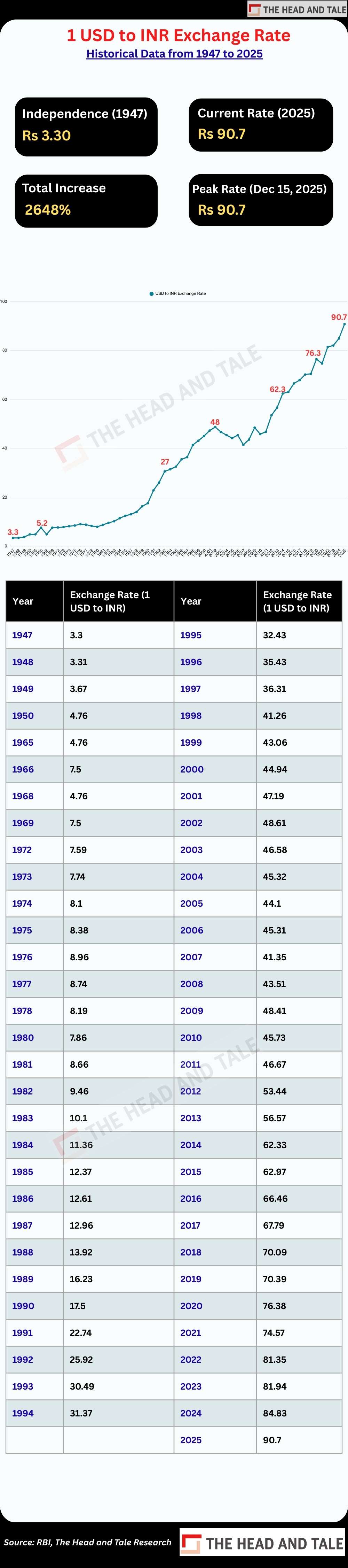
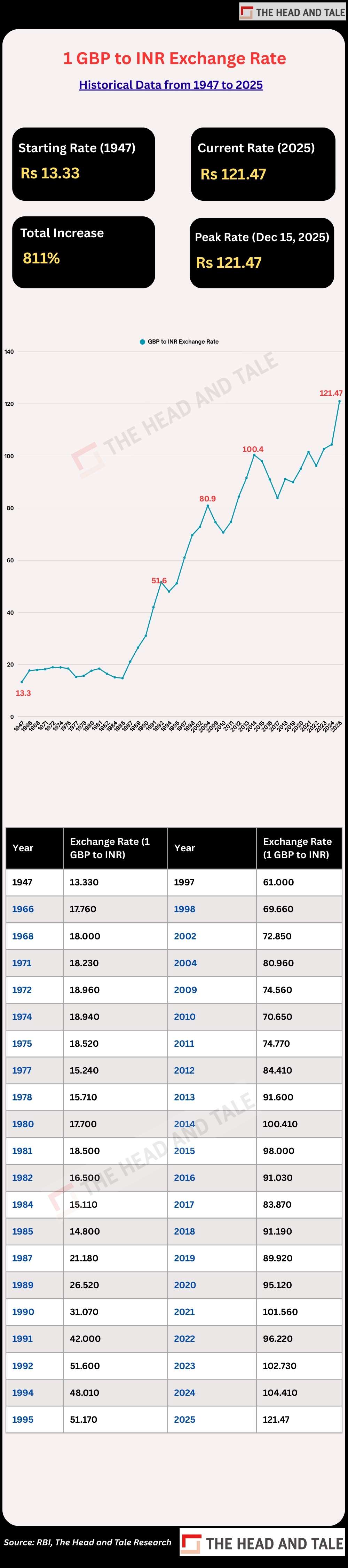
The Indian rupee’s journey since 1947 shows how the world around us has changed. When India became independent, Rs 3.30 equalled 1 USD, and Rs 13.33 equalled 1 GBP. At that time, India tightly controlled its economy, and the rupee was linked to the British Pound. Its stability had more to do with the global system India was part of than with India’s own economic strength.
Things started to change in the mid-1960s. Two wars, weak exports, and rising dependence on foreign aid put pressure on the rupee. This ended in the 1966 devaluation, when the rupee dropped from Rs 4.76 to Rs 7.50 per USD. Even the pound -- India’s old reference point -- went through several devaluations, showing that the fixed-rate world was no longer predictable.
The real shift came in 1991, during India's balance-of-payments crisis. The rupee was slowly moved away from a fixed rate to a market-driven one. Liberalisation meant the currency was no longer held up artificially; supply and demand began to decide its value. Since then, factors like India's trade deficit, foreign capital flows, dependence on oil imports, and inflation have shaped the rupee's steady, long-term decline.
This long slide has taken the rupee from Rs 17.90 per USD in 1991 to a peak of Rs 90.7 in December 2025. Against the pound, it has moved from Rs 13.33 in 1947 to Rs 121.47 today.
The Chinese yuan tells a different story. India began widely tracking its rate in the mid-1990s, just as China's economy was booming. In 1995, 1 CNY was Rs 4.19 -- and now it is Rs 12.8. The yuan has strengthened as China's export engine grew, while the rupee has weakened due to recurring current account pressures.
If you chart INR-USD, INR-GBP, and INR-CNY together, the rupee's biggest weakness appears against economies that either grew very fast (China) or stayed dominant in global finance (US, UK). After 1991, however, the rupee's fall has been smoother and more predictable compared to the sudden shocks of earlier decades.
Many sharp drops in the rupee have lined up with periods of high global oil prices -- a reminder that India’s currency is heavily influenced by its energy bill.
-------------------------------------------------------
-----------------------------------------------------
.jpg)
Who Reads Us
“I enjoy reading The Head and Tale for their coverage on the Fintech landscape. The reporting is incisive and honest, and it demonstrates a sharp understanding of the industry and the issues that concern it. I'd like to extend my best wishes to Arti for her continued success.”

“Well-researched, informative and analysis based reporting makes an interesting read. 'The Head and Tale' news portal has been demonstrating this quite well covering fintech and emerging tech sectors. Their timely updates, exclusive stories and different perspectives on these sectors help me stay informed. Kudos to Arti Singh for pursuing her passion and best wishes to the team.”

“The Head and Tale stands out for its deep industry knowledge and impressive network of sources. I especially appreciate that the reporting remains independent, rarely resorting to paid puff pieces, making it a publication I can genuinely trust. Having followed Arti’s work for years, I’ve come to rely on The Head and Tale for its unparalleled insight and truly independent coverage. Arti’s long-standing presence in the sector means her reporting is always informed, with access few can match.”

“What I really appreciate about The Head and Tale is that it doesn’t just report the news, it interprets it. The stories are well-researched, comprehensive, and bold. Arti brings a fearless lens to reporting, often asking the uncomfortable but necessary questions. She makes you pause, reflect, and rethink what it all means for the payments and fintech ecosystem. It’s rare to find journalism that’s this sharp, timely, and relevant to the work we do every day.”

“I’ve always valued journalism that goes beyond surface-level headlines. The Head and Tale does exactly that - it connects the dots, asks the tough questions, and brings clarity to the shifts shaping our evolving industry. I’ve even encouraged my team members to subscribe, because staying informed through credible, deeply reported stories is as important as building products. For me, The Head and Tale has become part of essential reading.”