
UPI MDR Explained: Who really gets the 40 basis points, and how much
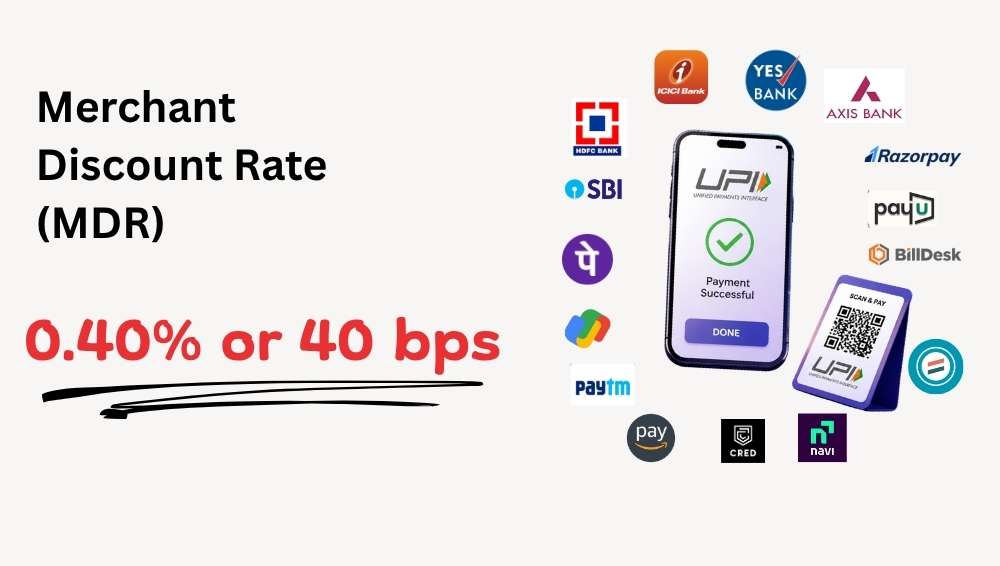
UPI's new 0.4% MDR grabbed headlines, but the real story is who profits. By our estimates, the top three UPI apps could get up to 40% of the MDR split.
 21 min read
Ever since the MDR was announced, the internet has been awash with memes, explainers and commentary from experts, journalists and social media influencers. With UPI accounting for more than 80% of India’s digital transactions, the topic was simply too good for the creator economy to pass up.
Amid all the noise and some pushback from merchant categories who feel the fee will hurt their margins, with certain associations even saying the industry will move to cash – the National Payments Corporation of India (NPCI), the government and founders and CEOs of the top payments companies have consistently said through notifications, press releases, video interviews that the move will not impact majority set of merchants as more than 95% of merchant transactions by volume will remain outside the MDR net.
While that may be true, but the statement is about the count. And, this piece is about value – who gets the money, how much there really is, and how merchants might work out ways to avoid paying it.
The interesting part of the new MDR policy isn't the 40 bps itself, but the chain of economics that sits behind that number.
In this deep-dive, we try to decode every important aspect and the calculations: Who gets the 40 paise? Why does the issuing bank get the biggest fixed share? Where does the payment aggregator (PA) fit in? Can a bank bypass the aggregator and go directly to the merchant? What happens to smaller TPAPs that have spent years building UPI business without making meaningful money from transactions? And most importantly, how much of the headline MDR pool will actually materialise once the Rs 2,000 threshold, sector-specific caps, exemptions and merchant behaviour are taken into account?
We will also look at how easy the execution of the MDR mandate going to be – assuming the regulators and banks spent enough time on the back-end calculations before issuing the notification.
And overall, we will try to understand what the whole fuss is about.
The number
Now, let’s understand the numbers to get a sense of the size of the MDR pool that the new framework could create. Take the August 2026 data for instance: The total P2M transaction value in the period is Rs 8,95,320.68 crore. Of this, 67% or about Rs 5,99,864.86 crore comes from transactions above Rs 2,000, which are eligible for the regular 40-basis-point MDR.
But a large portion of this value falls under the ‘Industry Programme’ categories, which include segments such as utilities, telecom, fuel and rail, where the MDR is capped at Rs 5 per transaction rather than being calculated as a percentage of the transaction value.
Now, as per the government data, the ‘Industry Programme’ transactions account for about 46% of the total P2M transaction value. For the purpose of calculating the MDR pool, however, the relevant number is transaction volume because the MDR is a flat Rs 5 per transaction. With total P2M transaction volume at 15,510.01 million and Industry Programme transactions accounting for 17% of that volume, this bucket works out to about 2,636.7 million transactions. At Rs 5 per transaction, this translates into an MDR pool of roughly Rs 1,318 crore.
That leaves around Rs 1,88,017 crore of P2M value in the regular MDR pool after excluding the Industry Programme transactions. Applying the 40-basis-point MDR to this value gives an estimated Rs 752.07crore. Put together, the two pools amount to roughly Rs 2,070 crore a month.
But the actual number the industry will realize is expected to be lower, once the other caps built into the framework are factored in. Two further adjustments trim the remaining "regular" pool. First, securities market and dealer transactions – a segment recording Rs 63,667 crore in August value, of which about 70% is estimated to fall above the Rs 2,000 threshold – have been proposed for a special, far lower MDR cap of just 0.02%.
Second, high-value transactions above Rs 75,000 are subject to their own cap – MDR capped at Rs 300 per transaction, regardless of ticket size. Assuming this segment makes up 1% of the remaining regular pool's value will be reduced further.
With some back of envelope calculation reduces the 0.40% regular MDR pool of roughly Rs 752 crore to somewhere around Rs 570-580 crore once the securities and Rs 75,000-plus carve-outs are accounted for.
The Rs 1,318 crore Industry Programme pool and the revised Rs 570-580 crore regular pool brings the industry's total estimated UPI MDR income at approximately Rs 1,800-1900 crore a month. This brings the annualized MDR income to somewhere around Rs 22,000-23,000 crore.
The reality is very different from what these annual figures suggest. The first thing to understand is that UPI MDR is not one pool of money that is handed to the industry. It is a distribution mechanism – where the actual game will be because that split could reshape the balance of power across the UPI ecosystem.
Who gets what
The 40 bps is split: 40% goes to the issuer bank, 30% to the acquirer bank, 20% to the UPI app and 10% to the app's PSP bank partner.
On a Rs 10,000 payment, where the merchant pays Rs 40: the issuing bank (customer's bank from where the money gets debited) gets 16 bps (Rs 16); the acquiring bank (whose merchant is it and where the merchant payments settlement happens) gets 12 bps (Rs 12); the UPI app (also known as TPAP, used by the customer to pay at merchant outlet) gets 8 bps (Rs 8); and the payer PSP (a bank which works with the TPAP) gets 4 bps (Rs 4).
In plain words, banks are cornering 80% of the MDR share.
.jpg)
Let’s understand it through an example: I pay Rs 10,000 through Paytm app from my ICICI Bank account. Paytm's PSP bank partner is Axis Bank. The merchant is accepting payment via a Paytm QR or a Pine Labs PoS machine to accept payment and the acquiring bank – on whose behalf the merchant was onboarded by Paytm or Pine Labs – is HDFC Bank.
Beyond the customer and merchant, a UPI transaction involves 5 parties:-
- On customer side: Issuing bank, TPAP (UPI app), TPAP’s bank partner (Payer PSP)
- On merchant side: Payment processor (QR, PoS machine, Online Payment Gateway), and the Acquiring Bank (the merchant is onboarded by the payment processor on behalf of this bank and the merchant payment settlement happens in this bank).
NPCI has set the MDR split for 4 parties, except for the payment processor. So, when Paytm and PhonePe – two companies, which have the largest presence both on customer side as TPAP and on seller/merchant side (where their QR/PoS/Online PG are used for collecting payments), look at this chain, one thing is clear that their 8 bps TPAP share is fixed and guaranteed, but their share on the merchant side is not set by NPCI at all.
"In cases where the merchant is acquired by an authorized payment aggregator (PA), the acquiring bank's share of MDR shall be distributed between the acquiring or sponsored bank and the PA in accordance with the terms of their business agreement," the NPCI circular states.
This means the share of payment processor will be based entirely on negotiations with its acquiring bank partner.
An industry official said the reason behind not setting a PA fee in this chain is because “NPCI cannot execute direct financial settlements for Payment Aggregators because they do not possess direct settlement accounts or clearing house membership with the NPCI. By regulatory design, settlement membership is restricted to banking institutions. Under current guidelines, only non-bank entities that hold direct settlement accounts with the Reserve Bank of India can be admitted as clearing house members. If the RBI decides to grant direct membership/settlement accounts to PAs (like they did for White Label ATMs), NPCI would then be in a position to review it. It is entirely RBI's decision to allow PAs as members of clearing house directly or not.”
The fair understanding in the market is that commercial arrangement between acquiring bank and the payment aggregator/processor could be 50:50, 60:40, or even 70:30.
“The cost of settlement is about 1-2 bps. So, the arrangement could also be that the acquiring bank keeps 2-3 bps to itself and pass the rest to the PA and PoS player,” one of the industry sources said.
Brief version
Scenario 1: Let’s assume that Paytm and PhonePe are the largest on the merchant side too – then they can make close to 6-9 bps from their acquiring bank partner as well.
Given their market dominance on customer side as TPAP, these two players, along with Google Pay, “could also negotiate on the issuing side with their Payer PSP bank partner to get some share from the 4 bps earning and pick up another 2 bps from them,” one of the bankers we spoke to said.
Taken together, these three TPAPs – who also happen to be the largest on the consumer side – may end up earning close to 16 bps or even higher – comparable to what the issuing bank will make.
Scenario 2: Here, the TPAP and payment processor are different entities. Let’s assume Pine Labs (PoS) or Razorpay (online payment gateway) as standalone payment processors – with no consumer facing play, they are expected to make some 6-9 bps from their acquiring bank partner.
“All PAs are negotiating with banks to get maximum out of the 30% acquiring share,” a top payment aggregator official said.
Now let’s see the Elaborate version of both scenarios – because there is more here than meets the eye.
Scenario 1:
The UPI MDR is going to take the market into two extremes – big becoming bigger and small becoming smaller – be it TPAPs, banks, and even merchants.
There are top three TPAPs account for 85% of volume and over 88% of transaction value – where PhonePe controls 48% (value) and 45.6% (volume); Google Pay follow with 34% value and 32% volume; and Paytm hold a decent share of 7% value and 8% volume. In that 10-15% market is where the rest of the ecosystem, including the likes of Cred, Navi, Super.money, WhatsApp, other fintech apps and bank apps, play.
In total, there are 41 TPAPs in the country. Overall, there are 92 apps, including bank apps, using which you can make UPI payments.
While this deserves to be a separate story, but it is very important to understand where smaller TPAPs fit into this celebration. Because their fight for even that 8 bps share is going to be difficult on multiple fronts.
“The whole exercise is about big becoming bigger, and the small becoming smaller,” said a small TPAP founder.
“The core problem for us as a small TPAP is that we are at the very bottom of the chain. We don't even get the 0.08% because our ticket size is small as large merchants are cornered by top players,” he explained.
“Our first challenge is as basic as the payments not going through. If a customer tries to use a small TPAP app, banks like HDFC or ICICI trigger security verification calls or decline the transaction for fraud checks asking customer to confirm whether they approve the transaction or no’. Customers panic and this spook them into switching to Google Pay or PhonePe. In credit cards, the verification calls happen post a transaction is done, but in UPI, you have to reinitiate the transaction again,” he shared.
“And merchants then de-prioritize our app due to high checkout failure rates.”
“Small TPAPs have been facing this issue for long and there is no support from the NPCI. Every second day, NPCI issues new circulars requiring us to deploy engineers for some updates and compliance fixes. We take all the blame and cost, while NPCI and PSP banks take no burden to solve our issue. All we have been asking NPCI is to issue a directive whitelisting our handles to banks so they stop blocking our UPI transactions with verification calls – because after all we are valid TPAPs.”
Second, the founder believes the small TPAPs have to fight tooth and nail to come up on the payment page of a large merchants like Amazon etc. "On merchant checkout pages, we first need to invest in building the intent flow. Then, once I am on the merchant’s checkout page, then every app on the customer’s phone shows up there too – so now I will have to fight for the visibility."
Do check out our previous story on this.
“How will money flow to anyone beyond the top 10 when we don't have money for cashbacks or direct integrations and if we are not showing on large merchants?,” he asked. He added that earlier, when nobody was making money, it didn't matter as much – but the dynamics have shifted now that MDR is in place.
“We are internally debating to surrender our TPAP licence,” he adds. Some small fintechs, including Niyo, Twid have already discontinued their UPI apps. Although the exact reasons behind those exits are not known.
All of this points to the fact that TPAPs – who are also sitting on the merchant side – are going to have a structural advantage. To compete, the rest of the TPAP ecosystem players will have to go aggressive on the acquiring side.
And, dethroning a decade of investment and monopoly is going to be extremely difficult for the rest of the fintech UPI apps (and even the top bank apps).
Why? Because the top three fintechs are expected to make close to 40% share as explained earlier.
And interestingly with such earning, these fintechs can afford to pass some of it to consumers via cashbacks and to merchants by letting go of some of their MDR share. So, if 40 bps is the earning, they can onboard merchants by offering say 35 bps – if the merchant uses their QR, PoS, or PG services. Net-net their monopoly would likely continue.
It is also worth remembering NPCI has already pushed back its own 30% TPAP market-share cap twice – most recently to December 2026 – while PhonePe and Google Pay alone hold close to 85% combined. Given where this MDR pool is headed, that deadline looks unlikely to hold either.
The big fintechs have started pushing narratives how much MDR is going to help them and boost their revenues and bottom-lines, with several industry officials believe the timing, just ahead of the IPO of PhonePe, the largest UPI player, is no coincidence. PhonePe had to pause its listing plans earlier this year amid reports that it wasn't getting the valuation it wanted; MDR, some say, has now handed it "the biggest story to sell to investors."
A senior payments industry official, however, pointed out that the NPCI circular also bars UPI apps from charging customers platform/convenience fees. PhonePe charges about Rs 1-4 on mobile recharges and some other payments. By rough estimates, PhonePe makes some hundred crore through platform/convenience fees. “This earning is now off the table,” the official added.
Scenario 2:
Coming to the other set of fintechs – that is pure play B2B payment aggregators.
The MDR framework leaves real ambiguity for this set of players. While PhonePe is expected to be the biggest beneficiary of the new policy on the consumer side, it is still not clear how this is going to play out for the likes of Razorpay – another IPO-bound payments firm but on the B2B side.
As we’ve reported earlier, new-age online payment aggregators like Razorpay, Cashfree, PayU among others were already charging merchants on UPI transactions under platform fee/technical fee/convenience fee etc until now. We've also written earlier about how tricky the MDR transition would be for firms already charging such fees.
NPCI’s circular says that UPI apps cannot charge platform fees from October 15. One may argue that this applies only to UPI apps and that while PAs could keep charging their fees – while separately negotiating a share with their acquiring bank.
A top payments industry official disagreed.
“If the circular clearly says no platform fees, then ideally it is for all,” the senior payments industry official stated.
“If the PAs are giving some services to the merchant such as a cloud/services platform providing value-added services to merchants, they can charge under commercial agreements. If PAs are acting as a services platform then they can charge for some services…but the moment they start adding per-transaction fees directly – that will be construed as a payment fees,” the official added. “Earlier what some PAs did, they did. But now they are going to attract the RBI scrutiny.”
For some context, don't miss our video explainer which we did earlier:
Only time will tell whether the PAs see this as a loophole and will continue charging what they charged before – repackaged as services – on top of whatever they earn from MDR.
Now, let us see how the banks are viewing this whole thing both on the consumer and merchant sides.
The top banks, some officials feel, will now try to protect their margins from all sides. Since top banks are also the largest issuer, who are going to get 16 bps, no matter who is the TPAP/PA/or Acquiring bank is. They have every incentive to invest in making their own bank apps more attractive to customers.
Interestingly, top issuer banks of the country are somewhere also the top Payer PSP and also aggressive players on the acquiring side – meaning several banks stand to be net gainers across the board.
With so much excitement on the MDR now among banks – who knows they must be thinking of turning UPI into something like a credit card instrument, where the MDR split is broadly among the issuer bank, acquirers bank and the card network. An official at a top private sector bank said, “As a bank, we are going to go really aggressive on the acquiring side. We can go direct and can onboard merchants by letting go of our 12 bps and offering them UPI payments above Rs 2000 at just 28 bps, in return we get the float from the current account we open for them.”
This may work in offline merchant acquiring, where banks can source merchants directly, but online is a different story – banks still lack the tech stack to operate there without PAs. The same banker noted that lenders are investing in their own tech regardless, and could eventually push payment aggregators into a TSP-like role, earning a thinner margin in the process.
A payments industry expert said, "In credit cards, the issuer owns the customer and cross-subsidises costs from interest income -- that's why interchange works. UPI is a debit mechanism, where the customer belongs to the bank, but the KYC, onboarding, fraud handling and app costs sit largely with the TPAP. The issuer bank getting the biggest share is the wrong call. And since all banks sit on the NPCI board, they ensure every policy tilts in their favour – otherwise none of this would happen."
On this, the senior industry official countered that the distribution formula is cost-plus, reflecting what each participant actually spends.
Even if we assume that banks will try to corner more of the margin, it remains to be seen how this plays out – because doing so would require a very different DNA and mindset from banks, one built around aggressively pushing their own UPI apps, QR codes and PoS machines across merchants.
Banks such as HDFC, ICICI, Axis and SBI – the biggest issuers, acquirers and, in some cases, payer PSPs (Yes Bank is the largest payer PSP overall) – are expected to invest heavily in their own apps over the next six months to two years, one of the bankers admitted.
The question is not whether they will try – but whether the banks can pull it off.
Large merchants, small merchants, one threshold
This is one part of the policy I understand least. For years, NPCI and the industry bodies have been pushing for UPI MDR on “large merchants”, with turnover above Rs 40 lakh or Rs 1 crore or so. What we have ended up with instead is a ticket-size threshold that ignores merchant size entirely.
Take Head and Tale Media Pvt Ltd, as an example. We offer a one-time news subscription priced at Rs 2,299, on which we would pay Rs 9.20 in MDR – even though our monthly sales are under Rs 1 lakh (a figure worth remembering, since it returns later in a more complicated context). A merchant like Reliance, Amazon or Flipkart, earning crores a month, pays the exact same Rs 9.20 on an identical Rs 2,299 transaction.
No one seems to have a good answer for this gap. One industry official suggested it was designed to "minimise disruption". “Small merchants don't generate much transaction value anyway, so the real revenue – optics aside – always lay with large merchants.”
In practice, though, banks and PAs will negotiate hard for large-merchant business, since everything in this market eventually comes down to throughput. That means acquiring margins on large-merchant transactions could effectively disappear – so large merchants may end up paying something closer to 30-32 bps on the same transaction where a merchant like Head and Tale pays the full 40 bps.
Add to this that most transactions in government, telecom, fuel, rail and insurance already carry the Rs 5 cap, which leaves e-commerce and retail as the segments most exposed to the regular MDR. Large merchants like Reliance and Amazon also tend to run their own acquiring operations with their own PAs and PoS infrastructure – so they may route the bulk of their transactions in-house, saving another 2-3 bps on the acquiring margin.
Interestingly, there's also a line in the NPCI notification about MDR applying to small merchants under the Person-to-Person Merchant (P2PM) framework – small vendors receiving up to Rs 1 lakh a month through UPI QR payments directly into their bank accounts (not current accounts, going by the wording).
This is the part that will be most interesting to watch play out on the ground, because it's both hard to implement and easy to game. Say a P2PM merchant accepts a mix of above- and below-Rs-2,000 UPI payments through PhonePe and Paytm QR codes all month, and crosses Rs 1 lakh in total on day 26. How does the MDR deduction get applied from that point on, and whose job is it to collect it?
It's entirely possible I'm missing something obvious here, and asking these questions makes me feel a little foolish – but I genuinely don't have an answer.
What is clear is how easy this would be to game: a shopkeeper could simply split collections across multiple family members' accounts to stay under the Rs 1 lakh threshold and avoid the fee altogether. The same logic could apply more broadly, too on regular P2M merchants pricing items just under Rs 2,000 wherever possible, or generating multiple invoices to sidestep the MDR entirely.
Bottomline
If that behaviour becomes widespread, we may see very different narratives emerge on the consumer and merchant sides. The government and NPCI have said clearly that no cost will be passed on to consumers – whether that holds remains to be seen.
On the merchant side, retail bodies and petrol pump dealers, among others, have already come out against the policy, some threatening a return to cash. Last week, the internet was full of MDR memes; at moments, it felt like the backlash might force a rollback. But at least for now, one industry official insists there's no chance of that happening.
Amid all this, one senior payments executive suggested the episode could end up boosting CBDC (central bank digital currency) adoption – with large e-commerce merchants potentially nudging customers to top up a CBDC wallet and pay via QR for transactions above Rs 2,000, to avoid paying MDR.
It is an interesting thought, though worth remembering that it took billions of dollars in VC money over a decade to get Indians comfortable with UPI in the first place. Getting them to learn a new payment habit for CBDC is a different order of challenge.
This time I will skip sharing my own opinion here. The only certainty right now is that everyone in this chain is negotiating for a cut of something that a lot of merchants are, at the same time, trying to find ways to avoid paying.